Table of Contents
ToggleArchitectural pendant lighting has moved beyond basic task lighting to become a defining element in modern home design. These statement fixtures combine form and function, offering focused illumination while serving as sculptural focal points that shape how a room feels and flows. Whether you’re planning a kitchen remodel, updating a dining area, or adding character to a hallway, the right pendant can elevate a space from ordinary to exceptional. This guide walks through everything a DIYer needs to know, from selecting the right style and size to tackling installation with confidence.
Key Takeaways
- Architectural pendant lighting combines sculptural design with focused task lighting, making it ideal for kitchen islands, dining tables, and entryways while serving as a defining focal point in modern home design.
- Proper sizing and hanging height are critical—choose pendants that are one-half to two-thirds the width of the surface below and hang them 30 to 36 inches above work surfaces to maximize both function and visual impact.
- Geometric forms, mixed materials (metal with wood or concrete), and oversized glass globes dominate 2026 design trends, allowing architectural pendants to adapt across contemporary, industrial, and Scandinavian interiors.
- DIY installation is achievable for most fixtures if you use a non-contact voltage tester, verify ceiling box support for heavier pendants, and follow proper wire connections (black-to-black, white-to-white, ground-to-ground).
- In multi-pendant arrangements, space fixtures 24 to 30 inches apart center-to-center, and for rooms with ceilings above 9 feet, add 3 inches of drop length per additional foot of ceiling height to maintain visual balance.
What Is Architectural Pendant Lighting?
Architectural pendant lighting refers to hanging fixtures designed with clean lines, geometric forms, and intentional structure, less frilly chandelier, more sculptural statement piece. Unlike decorative pendants that lean heavily on ornamentation, architectural styles emphasize materials like metal, glass, concrete, and wood in minimalist or industrial forms.
These fixtures typically hang from a ceiling canopy via a cord, chain, or rigid stem, suspending the light source anywhere from a few inches to several feet below the ceiling plane. The term “architectural” signals design intent: the fixture is meant to complement or contrast with the room’s structural elements, exposed beams, vaulted ceilings, or open floor plans.
You’ll find architectural pendants in single units or clustered arrangements. Single pendants work well over kitchen islands or reading nooks, while multi-pendant installations create visual rhythm in dining rooms or entryways. The style overlaps with mid-century modern, Scandinavian, and contemporary industrial aesthetics but adapts across design palettes when chosen thoughtfully.
Why Choose Architectural Pendant Lights for Your Home
Architectural pendants deliver both practical and aesthetic advantages that make them a smart choice for DIY renovators.
Task lighting with style. Unlike flush-mount ceiling lights that diffuse light broadly, pendants direct illumination downward, making them ideal for work surfaces, dining tables, and kitchen prep zones. A fixture with an open or translucent shade also provides ambient glow, reducing harsh shadows.
Visual layering. Pendant fixtures add vertical dimension to a room. In spaces with high ceilings, they bring the eye down and create intimacy. In rooms with standard 8- or 9-foot ceilings, a low-profile pendant adds interest without crowding.
Material flexibility. Metal shades offer durability and easy cleaning, important in kitchens where grease and steam are factors. Glass pendants (clear, frosted, or seeded) soften light and suit transitional or coastal interiors. Concrete and wood bring texture and warmth, especially in modern farmhouse or Scandinavian settings.
Scalability. Architectural pendants range from compact 6-inch drum shades to oversized 24-inch+ globes, making it easier to match fixture scale to room proportions and ceiling height. You can also mix pendant sizes within the same material family for a curated, non-matchy look.
Popular Styles and Design Trends
Architectural pendant styles evolve, but a few core trends dominate in 2026.
Geometric and linear forms. Hexagons, cylinders, cones, and rectangular frames continue to lead, especially in matte black, brushed brass, and aged bronze finishes. These shapes pair well with modern cabinetry and open shelving.
Mixed materials. Combining metal frames with wood accents, concrete with brass details, or woven rattan with metal hardware adds depth. This trend fits the broader move toward layered, collected interiors rather than catalog-matched sets.
Oversized globes and domes. Large-scale glass or metal spheres make bold statements over kitchen islands or dining tables. Smoked glass and ribbed textures are particularly popular, softening light while maintaining a clean profile. Designers featured in curated pendant collections often highlight these as anchor pieces.
Industrial minimalism. Exposed bulbs, cage frames, and raw metal finishes remain staples for lofts, basements, and garage workshops. These fixtures work especially well in spaces with exposed ductwork or concrete floors.
Natural and organic shapes. Woven pendants in jute, rattan, or bamboo bring warmth to coastal or boho-inspired interiors. They’re lightweight, forgiving to install, and soften the angularity of modern kitchens. For those drawn to more traditional elegance, crystal chandeliers offer a contrasting approach with rich detail and sparkle.
Where to Install Architectural Pendant Lighting
Strategic placement maximizes both function and visual impact.
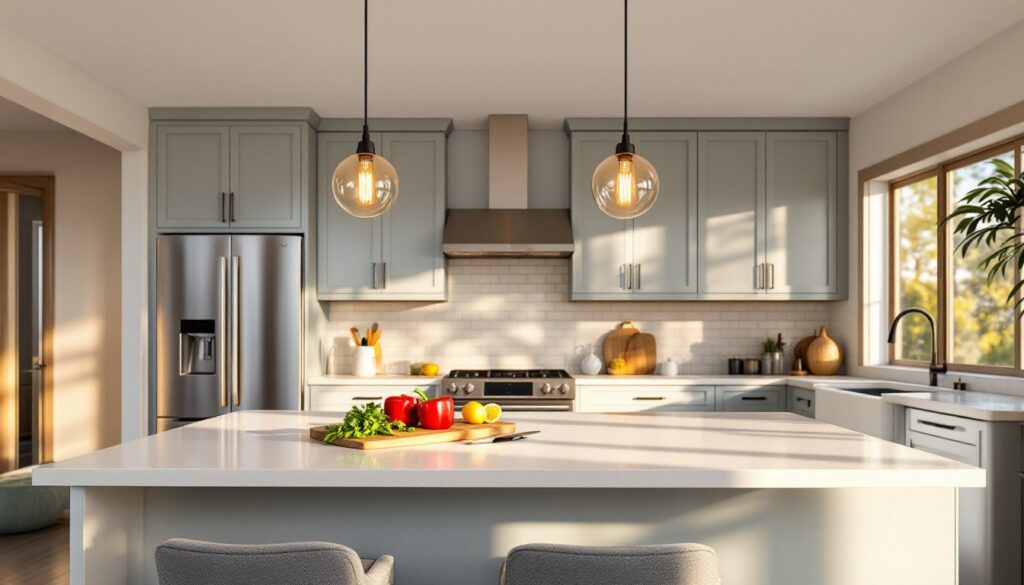
Kitchen islands and peninsulas. This is the most common application. Install pendants 30 to 36 inches above the countertop for task lighting that doesn’t obstruct sightlines. For islands longer than 6 feet, use two or three pendants spaced evenly, typically 24 to 30 inches apart, centered over the work surface.
Dining tables. Center the fixture (or a linear cluster) over the table, hanging the bottom of the shade 30 to 34 inches above the tabletop. This keeps light focused on diners without glare. In rooms with adjustable-height tables or mixed seating, aim for the lower end of that range.
Entryways and foyers. A single statement pendant or a tiered arrangement can anchor a two-story entry. For standard 8- to 9-foot ceilings, maintain at least 7 feet of clearance from the floor to the bottom of the fixture to avoid head strikes. In taller spaces, scale up fixture size and drop length accordingly.
Bathrooms. Pendants work well flanking mirrors or over freestanding tubs, provided you follow NEC wet and damp location ratings. Fixtures within 8 feet horizontally and 3 feet vertically of a tub or shower must be rated for damp or wet locations. Check local codes, some jurisdictions are more restrictive.
Hallways and stairwells. Linear or globe pendants spaced at regular intervals add rhythm and improve safety lighting. In stairwells, ensure bottom clearance meets code (usually 6’8″ minimum over treads) and use fixtures rated for sloped-ceiling mounting if needed.
Many modern interior lighting schemes layer pendants with recessed or track lighting for flexibility and redundancy.
Choosing the Right Size and Height
Getting proportions right is critical. An undersized pendant disappears: an oversized one overwhelms.
Diameter and width. For pendants over tables or islands, a general rule is to choose a fixture (or cluster width) that’s one-half to two-thirds the width of the surface below. For a 36-inch-wide island, pendants ranging from 12 to 18 inches in diameter work well. Over dining tables, you can go larger, up to 24 inches for a 60-inch round table.
Height and drop length. Measure from the ceiling to the desired bottom height, then subtract the fixture’s own height to determine the correct stem or cord length. Most pendants ship with adjustable cords or stems that can be shortened during installation. If you need extra length for a vaulted ceiling, order extension rods or chain.
For task lighting (islands, desks), hang the fixture 30 to 36 inches above the surface. For ambient or decorative applications (entryways, living rooms), aim for 7 feet minimum clearance from the floor.
Multi-pendant spacing. When installing two or three pendants in a row, space them 24 to 30 inches apart, measured center to center. For islands or tables with distinct zones (prep, eating, serving), align pendants with those functional areas rather than strict geometric symmetry.
Ceiling height adjustments. In rooms with ceilings above 9 feet, add 3 inches of drop for every additional foot of ceiling height. A 12-foot ceiling calls for pendants hanging roughly 9 inches lower than they would in an 8-foot room to maintain visual balance.
Installation Tips for DIY Homeowners
Most architectural pendants are DIY-friendly if you’re comfortable with basic electrical work. If not, hire a licensed electrician, especially for new junction boxes or circuits.
Shut off power at the breaker. Use a non-contact voltage tester to confirm the circuit is dead before touching any wires. This is non-negotiable.
Check box support. Standard plastic ceiling boxes are rated for fixtures up to 50 pounds. Heavier pendants (metal, concrete, or multi-light clusters) require a metal box rated for fan or fixture support, securely fastened to a ceiling joist or blocking. If the existing box is plastic or wobbly, replace it. Retrofit fan-rated boxes with adjustable bars work well for remodel situations.
Wire connections. Most pendants use straightforward connections: black (hot) to black, white (neutral) to white, and bare copper or green (ground) to the ground screw or wire. Use wire nuts rated for the wire gauge, typically 14 AWG or 12 AWG for lighting circuits. Twist wires clockwise, then twist on the nut until snug. Tug gently to confirm.
Adjust cord or stem length. For corded pendants, you can often shorten the cord inside the canopy by coiling excess and securing it with a cable tie. For stem-mounted fixtures, remove sections of the threaded rod and rethread the fixture. Don’t cut the electrical wire shorter than the structural support, leave slack for future adjustments.
Dimmer compatibility. If installing a dimmer switch, verify it’s compatible with your bulb type. LED bulbs require LED-rated dimmers: older incandescent dimmers can cause flickering or buzzing. Many contemporary lighting fixtures ship with integrated LEDs, so check the spec sheet before purchasing a dimmer.
Sloped ceilings and angled mounting. Some pendants include swivel canopies for sloped installations. If yours doesn’t, use a sloped ceiling adapter (available at most hardware stores) to keep the fixture plumb.
Permits and inspections. In most jurisdictions, replacing an existing fixture on the same circuit does not require a permit. Adding a new circuit, relocating a junction box, or installing fixtures in wet locations (bathrooms, covered porches) typically does. Check with your local building department. Kitchen remodels often trigger permit requirements for electrical, plumbing, and structural changes.
Safety gear. Wear safety glasses when working overhead, especially when drilling into drywall or plaster. Use a sturdy ladder or scaffold, not a chair or countertop.
For homeowners exploring alternative overhead solutions, vintage lighting fixtures offer character-rich options that often pair beautifully with modern architectural pendants in eclectic spaces. Projects featured on sites like Design Milk frequently showcase mixed-era lighting schemes that balance old and new.
Conclusion
Architectural pendant lighting brings together clean design, focused illumination, and the flexibility to shape a room’s character. By choosing the right style, sizing fixtures to your space, and following sound installation practices, DIYers can achieve professional-grade results without the contractor invoice. Take your time with measurements, respect the electrical work, and don’t be afraid to mix materials or finishes to make the project your own.