Table of Contents
ToggleBlack pendant lights have become a go-to choice for homeowners looking to add drama and definition to their kitchen islands. They anchor the space visually, provide focused task lighting exactly where it’s needed, and work with nearly any color palette, from all-white minimalist kitchens to warm wood-toned spaces. Unlike brushed nickel or polished chrome fixtures that can read as generic, black pendants make a deliberate design statement without overwhelming the room. Whether someone is planning a full kitchen remodel or just swapping out dated fixtures, modern black pendants deliver both function and style with minimal effort.
Key Takeaways
- Modern black pendant lighting for kitchen islands combines dramatic design with practical task lighting, providing visual contrast that anchors the space while working seamlessly with any color palette.
- Choose pendant diameter at one-third to one-half the width of your island, space multiple fixtures 24–30 inches apart, and hang them 30–36 inches above the countertop for optimal function and aesthetics.
- Black pendant fixtures hide dust and fingerprints better than lighter finishes, support LED bulbs with 15,000–25,000 hour lifespans, and significantly reduce energy costs in high-traffic kitchen environments.
- Select from industrial styles with exposed bulbs, minimalist geometric designs with frosted diffusers, or mixed-material options that adapt to farmhouse, contemporary, transitional, industrial, or Scandinavian kitchen aesthetics.
- Ensure electrical compatibility by using TRIAC or ELV dimmers with LED-equipped black pendants, confirm ceiling boxes are fixture-rated rather than smoke detector-rated, and hire a licensed electrician if you’re uncertain about any wiring work.
Why Modern Black Pendant Lights Are Perfect for Kitchen Islands
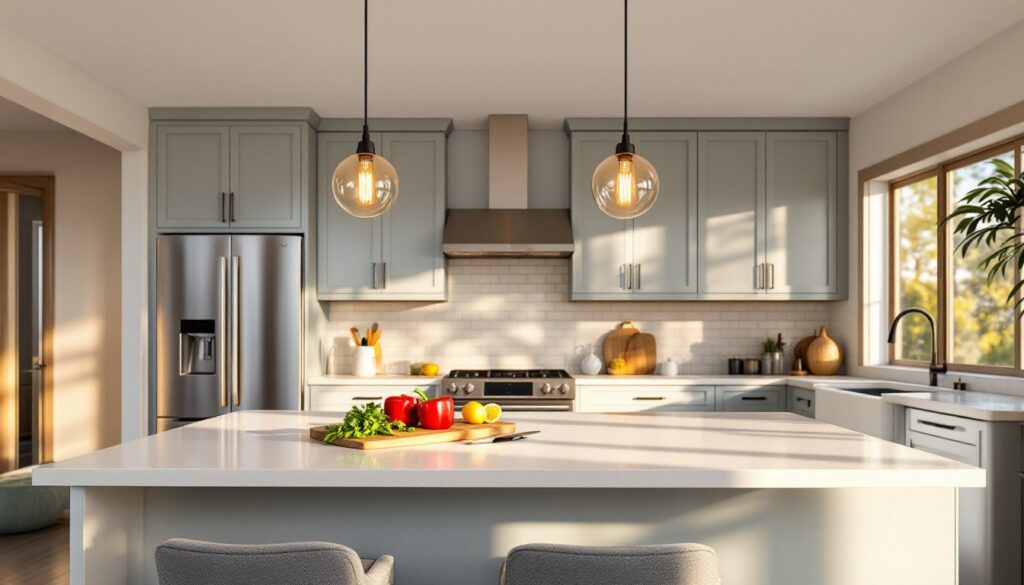
Black pendant lighting works because it creates contrast. In a kitchen dominated by light cabinetry, stainless appliances, and neutral countertops, black fixtures add visual weight and draw the eye exactly where it belongs, over the island, which is often the functional heart of the room.
Versatility is another major advantage. Black pairs seamlessly with virtually every finish: brass hardware, matte white tile, natural wood, concrete, or marble. It doesn’t compete with other design elements: it supports them. This makes black pendants a safe bet for homeowners who plan to update their kitchen incrementally over time.
From a lighting standpoint, pendants over an island provide task lighting where prep work, cooking, and casual dining happen. Unlike recessed cans, which spread light broadly but can create shadows on work surfaces, pendants deliver focused downlight. Most modern black pendants accommodate LED bulbs (typically 9–12 watts for equivalent 60W incandescent output), which means lower energy costs and longer bulb life, often 15,000–25,000 hours before replacement.
Black fixtures also tend to hide dust, fingerprints, and minor wear better than lighter finishes. In a high-traffic kitchen environment, that’s a practical win.
Top Styles of Black Pendant Lighting for Modern Kitchens
Not all black pendants are created equal. The style dictates the overall vibe of the kitchen, so it’s worth understanding the main categories before making a choice.
Industrial Black Pendants
Industrial-style pendants typically feature metal shades with exposed bulbs or wire cage guards. Think barn-style domes, conical metal shades, or Edison bulb-style fixtures with minimal ornamentation. These work especially well in kitchens with open shelving, subway tile, or reclaimed wood accents.
Materials often include powder-coated steel or matte black aluminum. The finish should be durable enough to resist scratching and chipping, look for multi-coat powder coating if longevity matters. Industrial pendants usually hang from fabric-wrapped cords or black metal rods, which add to the utilitarian aesthetic.
These fixtures often use E26 medium-base sockets, making bulb replacement straightforward. For a warmer look, pair them with 2700K LED filament bulbs: for crisper task lighting, go with 3000K or 3500K.
Minimalist Geometric Designs
Geometric pendants lean into clean lines and simple forms: spheres, cylinders, hexagons, or angular cages. They’re ideal for contemporary kitchens with flat-panel cabinetry, quartz countertops, and streamlined hardware. Materials range from matte black metal to combinations of black and brushed brass or natural wood accents.
Minimalist designs often incorporate frosted glass diffusers or opal acrylic shades to soften the light and reduce glare. This is especially important if the pendants hang at eye level when someone is seated at the island. A frosted diffuser spreads light more evenly and prevents harsh shadows.
These fixtures frequently come with adjustable cord lengths or integrated dimmers, allowing for customization based on ceiling height and personal preference. Expect to see integrated LED modules in higher-end models, which eliminate bulb replacement but require compatible dimmer switches (more on that later).
How to Choose the Right Size and Height for Your Island Pendants
Getting the scale and placement wrong is the fastest way to ruin an otherwise great lighting plan. Here’s how to dial it in.
Pendant diameter: A general rule is to choose fixtures that are one-third to one-half the width of the island. For example, if the island is 36 inches wide, pendants should be roughly 12–18 inches in diameter. For longer islands, multiple smaller pendants (8–12 inches each) often work better than a few oversized ones.
Spacing: When hanging multiple pendants, space them 24–30 inches apart (center to center). This provides even light distribution without creating a cluttered look. For a standard 6-foot island, three pendants is typical: for an 8-foot island, consider four.
Mounting height: The bottom of the pendant should hang 30–36 inches above the island countertop. This range provides ample task lighting without obstructing sight lines. If the ceiling is higher than the standard 8 feet, adjust upward proportionally, but don’t exceed 40 inches or the light will lose effectiveness.
Measure from the finished countertop surface, not the floor. And if the island has seating, ensure pendants don’t hang so low that they block conversation or create head-clearance issues for anyone standing.
Visual weight matters. A large, solid metal dome reads as heavier than an airy wire-cage pendant, even if they’re the same diameter. In a smaller kitchen, lighter designs prevent the space from feeling cramped. Many design inspiration galleries showcase how different pendant styles interact with island proportions and ceiling heights.
Installation Tips for Black Pendant Lighting
Installing pendant lighting isn’t overly complex, but it does involve electrical work. If there’s any doubt about working with live wiring, hire a licensed electrician. Most jurisdictions require permits for new electrical installations, though replacing an existing fixture on the same circuit typically doesn’t.
Electrical requirements: Most black pendants run on standard 120V household current and connect to a junction box via a mounting bracket and wire nuts. Confirm the junction box is rated to support the fixture’s weight, ceiling boxes rated for fixtures (not just for smoke detectors) are required. If the pendant weighs more than 50 pounds, install a fan-rated box or add additional bracing.
Dimmer compatibility: If the fixture uses LED bulbs or has an integrated LED module, use a TRIAC or ELV (electronic low-voltage) dimmer. Standard incandescent dimmers can cause flickering or buzzing with LEDs. Check the manufacturer’s spec sheet for recommended dimmer models.
Wire management: Black pendants often come with adjustable cord or rod lengths. Measure the desired hanging height before installation, and trim excess cord if needed. Some fixtures use a cord grip or set screw to lock the cord at the chosen length: others require cutting and re-terminating the wiring. If cutting, leave an extra 6 inches of slack inside the canopy for future adjustments.
Safety gear: Wear safety glasses when working overhead, and use a sturdy step ladder or scaffold, never a chair or stool. Turn off power at the breaker, not just the wall switch, and use a non-contact voltage tester to confirm wires are dead before touching them.
Leveling multiple pendants: When installing two or more pendants, use a laser level or taut string line to ensure they hang at the same height. Even a 1-inch difference is noticeable from across the room.
For kitchens with small spaces and organization challenges, pendant placement should account for cabinet doors, range hoods, and traffic flow to avoid collisions.
Pairing Black Pendants with Different Kitchen Design Styles
Black pendants adapt to a surprising range of kitchen aesthetics. The key is matching the fixture’s details, finish, shape, and materials, to the overall design language.
Modern farmhouse: Pair black pendants with shiplap, butcher block countertops, and white subway tile. Choose fixtures with subtle vintage details, like seeded glass shades or black metal with a slightly weathered finish. Avoid overly sleek or geometric designs, which can clash with the rustic warmth.
Contemporary or minimalist: Go for clean-lined geometric pendants in matte black with no visible hardware. Pair them with flat-panel cabinetry, quartz or concrete countertops, and stainless or integrated appliances. Keep the color palette neutral, white, gray, black, and natural wood, and let the pendants serve as sculptural elements.
Transitional kitchens: These blend traditional and modern elements, so black pendants with mixed materials, like black metal combined with clear glass or warm brass accents, work well. They bridge the gap between classic Shaker cabinets and contemporary finishes like matte black faucets or marble backsplashes.
Industrial or loft-style: Embrace raw materials and bold contrasts. Black pendants with exposed bulbs, wire cages, or oversized metal shades pair naturally with concrete floors, exposed ductwork, and stainless steel appliances. Add warmth with reclaimed wood open shelving or a brick accent wall.
Coastal or Scandinavian: Black pendants might seem counterintuitive in light, airy kitchens, but they provide the grounding contrast these styles need. Choose smaller, simpler fixtures in matte black, and pair them with white oak cabinetry, soft gray walls, and natural fiber accents. The black adds definition without heaviness.
For homeowners seeking more modern home decor ideas and inspiration, experimenting with finish combinations, black with brass, wood, or marble, can elevate the overall design without requiring a full remodel.
Final considerations: Before committing to black pendants, test them with the kitchen’s existing lighting. Turn on under-cabinet lights, recessed cans, and natural light from windows to see how the black finish interacts. In some cases, a semi-matte or satin black finish reflects just enough light to avoid looking flat, while still maintaining the bold look.