Table of Contents
ToggleGlass mini pendant lights pack a lot of style into a small package. They’re compact fixtures that hang from the ceiling on a single cord or rod, typically featuring a glass shade around a bulb. Unlike larger pendants or chandeliers, these smaller versions offer focused task lighting without overwhelming a space. They’re ideal for kitchens, bathrooms, hallways, and anywhere you need functional light with a design punch. Whether you’re installing a single fixture over a nightstand or spacing three in a row over a kitchen island, glass mini pendants deliver versatility that few other fixtures match.
Key Takeaways
- Glass mini pendant lighting combines functional task lighting with elegant design, measuring 4 to 8 inches in diameter and adapting to kitchens, bathrooms, hallways, and bedside spaces without overwhelming smaller rooms.
- Mini pendants offer scalability, height flexibility, and cost efficiency (starting at $40–$80 per fixture), making them ideal for both single installations and grouped arrangements over islands or bars.
- Glass shade options like clear, frosted, seeded, and colored varieties serve different purposes—clear showcases decorative bulbs, while frosted and seeded glass reduce glare and hide dust better in moisture-prone areas.
- Proper installation requires turning off power at the breaker, inspecting the junction box, matching black-to-black and white-to-white wire connections, and securing the canopy flush against the ceiling.
- LED bulbs are the most efficient choice for glass mini pendants, lasting 15,000–25,000 hours and using 75% less energy than incandescent equivalents while generating minimal heat in enclosed shades.
- Optimal placement requires hanging mini pendants 28–36 inches above work surfaces for kitchen islands, spacing them 24–30 inches apart, and adjusting color temperature (2700K for cozy spaces, 4000K for task areas) based on room function.
What Is Glass Mini Pendant Lighting?
A glass mini pendant is a small-scale hanging light fixture, usually measuring 4 to 8 inches in diameter or width. The defining feature is the glass shade, which can be clear, frosted, seeded, or colored. The pendant typically hangs from a stem, cord, or chain attached to a canopy mounted to the ceiling electrical box.
Mini pendants differ from standard pendant lights mainly in size and application. While a standard pendant might measure 10 to 18 inches across and serve as a room’s primary light source, mini pendants function as accent or task lighting. They’re designed to be used individually in tight spaces or grouped in multiples for broader coverage.
The glass component serves both aesthetic and practical purposes. It protects the bulb, diffuses light to reduce glare, and adds visual interest. Clear glass shows off decorative filament bulbs, frosted glass softens the light output, and seeded or textured glass creates ambient patterns on surrounding surfaces.
Most mini pendants use a standard E26 medium base socket and are compatible with LED, CFL, or incandescent bulbs up to a specified wattage (commonly 60W for incandescent, though LED equivalents use far less). Some models come with integrated LED modules that aren’t user-replaceable.
Why Choose Glass Mini Pendants for Your Home
Glass mini pendants solve specific lighting challenges that larger fixtures can’t address. Their compact footprint makes them perfect for spaces with low ceilings or narrow zones where a full-size pendant would feel bulky.
Key advantages include:
- Scalability: Install one over a sink or five in a row over a bar, mini pendants adapt to the layout.
- Height flexibility: Adjustable cords or stems let you dial in the exact drop, critical for task lighting at counters or desks.
- Visual lightness: Glass adds elegance without the visual weight of metal or fabric shades.
- Easy retrofits: Swapping out a dated fixture for a mini pendant typically uses the existing junction box and doesn’t require structural changes.
- Cost efficiency: Quality mini pendants start around $40 to $80 per fixture, making multiples affordable for most budgets.
From a design standpoint, glass works in nearly any style. A clear glass globe suits modern or industrial interiors, while mercury glass or vintage-style shades complement traditional or farmhouse aesthetics. This adaptability is why homeowners working on kitchen and bathroom updates often turn to mini pendants as a quick way to refresh the space without a full remodel.
Popular Glass Mini Pendant Styles and Finishes
Glass mini pendants come in a range of shapes and finishes. Choosing the right style depends on the room’s architecture, existing finishes, and how much light diffusion you need.
Common shade shapes:
- Globe or sphere: Timeless and symmetrical, works in modern or transitional spaces.
- Bell or dome: Directs light downward, ideal for task areas like kitchen islands.
- Cylinder or drum: Clean-lined and contemporary, often used in pairs.
- Schoolhouse: A classic rounded or flared shape with a vintage vibe.
- Geometric (cube, teardrop, etc.): Adds architectural interest, popular in mid-century or eclectic designs.
Glass finishes and effects:
- Clear glass: Maximum light transmission: showcases bulb filaments. Best with LED Edison-style bulbs.
- Frosted or opal glass: Softens glare and hides the bulb. Great for bathrooms or bedrooms.
- Seeded or bubble glass: Adds texture and creates subtle light patterns. Hides dust and fingerprints better than clear glass.
- Colored glass (amber, smoke, blue): Tints the light output and makes a bold style statement.
- Mercury or silvered glass: Reflective finish with an antique look: diffuses light while adding shimmer.
Hardware finishes (the canopy, stem, and socket) typically come in brushed nickel, oil-rubbed bronze, matte black, brass, or chrome. Match these to cabinet hardware, faucets, or door pulls for a cohesive look. Mixing metals is acceptable, but keep the overall palette to two or three finishes max.
Best Rooms and Placements for Glass Mini Pendants
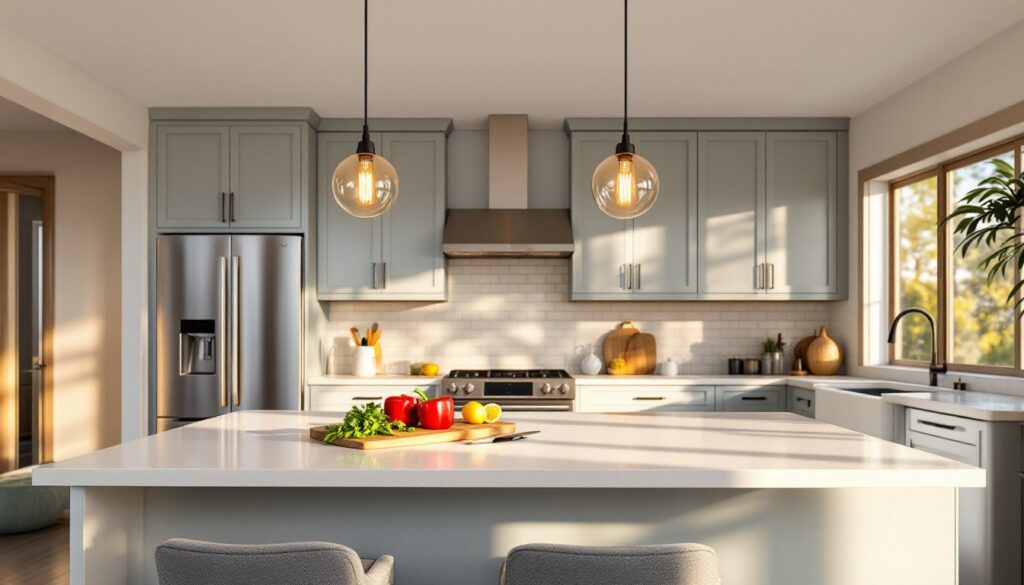
Kitchen: The most common application. Hang mini pendants 30 to 36 inches above a countertop or island surface. For an island, space fixtures 24 to 30 inches apart (center to center). If the island is 6 feet long, three pendants work well: for 4 feet, two suffice. Avoid blocking sightlines across the room, pendants should hang low enough to light the work surface but not interfere with conversation.
Bathroom: Use a single mini pendant on each side of a mirror for balanced task lighting, or center one above a smaller vanity. Ensure fixtures are rated for damp locations if installed near a tub or shower (check the UL listing). Glass shades are easier to clean than fabric in moisture-prone areas.
Hallways and entryways: A row of mini pendants down a hallway adds drama and visual rhythm. Maintain 6 to 8 feet between fixtures for even coverage. In an entryway, a single statement pendant over a console table creates a focal point without the bulk of a chandelier.
Bedside lighting: Replace table lamps with hardwired mini pendants to free up nightstand space. Mount the junction box 18 to 24 inches out from the wall and adjust the cord so the bottom of the shade sits 20 to 26 inches above the mattress top, high enough to avoid head bumps, low enough for reading.
Dining nooks and breakfast bars: Mini pendants work where a full chandelier is overkill. Hang them 28 to 34 inches above the table surface.
For design inspiration and curated fixture ideas, many homeowners browse remodel galleries to see how designers use multiples to create impact.
How to Install Glass Mini Pendant Lighting
Before you start: Turn off power at the breaker, not just the wall switch. Use a non-contact voltage tester to confirm the circuit is dead. If you’re uncomfortable working with electrical wiring, hire a licensed electrician. Most jurisdictions require permits for new wiring or junction box relocation, though replacing an existing fixture on the same box typically doesn’t.
Tools and materials:
- Wire strippers
- Screwdriver (Phillips and flathead)
- Adjustable wrench or pliers
- Wire nuts (often included with the fixture)
- Electrical tape
- Ladder or step stool
- Safety glasses
Installation steps:
- Remove the old fixture. Unscrew the canopy, disconnect wire nuts, and lower the fixture. Note how wires were connected (typically black to black, white to white, bare copper to green or bare ground).
- Inspect the junction box. It should be securely fastened to a ceiling joist or blocking. A standard 4-inch round or octagonal box works for most mini pendants. If the box is loose or damaged, secure it or replace it before proceeding.
- Thread the pendant wires. If the pendant has an adjustable cord, set the desired drop length now. Thread the fixture wires (usually black, white, and green or bare) through the canopy and stem.
- Connect the wires. Match fixture black (hot) to house black, white (neutral) to white, and ground to ground. Twist wires clockwise with pliers, then secure with a wire nut. Tug gently to confirm a solid connection. Wrap the base of each wire nut with electrical tape for extra security.
- Attach the canopy. Tuck wires into the junction box. Align the canopy screw holes with the box’s threaded posts or crossbar, then fasten with the provided screws. The canopy should sit flush against the ceiling.
- Install the shade and bulb. Most glass shades attach with a threaded collar or set screw at the socket. Screw in the appropriate bulb (see the next section), then restore power and test.
Adjusting pendant height: Many pendants use a cord-and-collar system. Loosen the collar at the canopy, slide the cord to the desired length, and retighten. Trim excess cord only if you’re certain you won’t need the length later, it’s easier to shorten than to extend.
For budget-conscious DIYers, platforms like Instructables offer creative workarounds and hacks, including tutorials on frosted glass pendant upgrades that cost under $10.
Choosing the Right Bulbs and Light Output
Bulb selection affects both the quality of light and energy costs. Always check the fixture’s maximum wattage rating (stamped on the socket or listed in the installation manual). Exceeding this can overheat the fixture and create a fire hazard.
LED vs. incandescent vs. CFL:
- LED bulbs are the most efficient, lasting 15,000 to 25,000 hours and using about 75% less energy than incandescent. A 9W LED produces the same light as a 60W incandescent.
- Incandescent bulbs are inexpensive upfront but costly to run and generate significant heat, not ideal in glass enclosures.
- CFL bulbs save energy but contain mercury, take time to warm up, and don’t dim smoothly. Avoid them in frequently switched fixtures.
Color temperature (measured in Kelvin):
- 2700K (warm white): Yellowish glow similar to incandescent: cozy for living areas and bedrooms.
- 3000K (soft white): Neutral tone: versatile for kitchens and dining areas.
- 4000K (cool white): Crisp, bright: good for task lighting in workshops or garages.
- 5000K+ (daylight): Bluish-white: mimics noon sunlight, best for detail work or bathrooms.
For task lighting (kitchen islands, desks), aim for 450 to 800 lumens per fixture. For ambient or accent lighting (hallways, bedside), 200 to 400 lumens is usually sufficient.
Dimmability: If you’re installing a dimmer switch, buy bulbs labeled “dimmable.” Not all LEDs dim smoothly: look for brands that specify compatibility with standard TRIAC dimmers. Test before buying multiples.
Bulb shape and visibility: In clear glass shades, the bulb is part of the design. A19 or G25 globe bulbs with visible LED filaments (sometimes called Edison-style or vintage LEDs) add character. In frosted or seeded glass, standard A19 bulbs work fine since they’re hidden.
Conclusion
Glass mini pendant lighting bridges the gap between function and style, delivering focused illumination without crowding a room. Whether you’re tackling a kitchen remodel, refreshing a bathroom, or adding character to a hallway, these fixtures adapt to nearly any layout and aesthetic. Measure carefully, respect electrical safety, and choose bulbs that match the task. With the right placement and a little planning, mini pendants transform ordinary spaces into well-lit, design-forward rooms.