Table of Contents
ToggleLighting your walkway, patio, or garden beds doesn’t require running 120-volt household current through your yard. 12-volt outdoor lighting offers a safer, more forgiving alternative that delivers professional-looking results without the permitting headaches or electrocution risk. These low-voltage systems step down standard household current through a transformer, allowing homeowners to install landscape lighting with basic hand tools and minimal electrical know-how. Whether highlighting architectural features, improving nighttime safety, or simply adding curb appeal, 12-volt systems strike a practical balance between performance, cost, and DIY-friendliness.
Key Takeaways
- 12-volt outdoor lighting systems are safer than 120-volt alternatives, delivering minimal shock risk and eliminating most permitting requirements while still achieving professional results.
- LED fixtures used in 12-volt outdoor lighting consume 1–4 watts per fixture and can reduce landscape lighting energy costs by 75% compared to older halogen systems, costing just $1.50 annually to operate.
- A properly sized transformer, low-voltage cable (12-gauge or 14-gauge), quality fixtures, and connectors are the essential components needed for a complete 12-volt system that most homeowners can install in an afternoon.
- Common fixture types include path lights for walkway safety, spotlights for highlighting architectural features, well lights for clean ground illumination, and deck lights for stairs—each addressing specific outdoor lighting needs.
- Voltage drop at distant fixtures is the most common installation issue; prevent dimming by using appropriately sized cable gauge, keeping runs under 100 feet, or adding a second transformer for extended zones.
- 12-volt systems avoid costly electrician visits for installation since no trenching or conduit is typically required, making DIY projects affordable with basic hand tools and minimal electrical knowledge.
What Is 12 Volt Outdoor Lighting and How Does It Work?
A 12-volt outdoor lighting system operates at a fraction of standard household voltage. Instead of running 120 volts directly to fixtures, a transformer (also called a power pack) reduces the voltage to 12 volts. This transformer plugs into a standard GFCI-protected outdoor outlet and connects to low-voltage cable that feeds your light fixtures.
The transformer typically mounts near the power source, on an exterior wall, inside a garage, or tucked beneath a deck. Most units include a built-in timer, photocell, or both, allowing automatic on/off scheduling. Wattage capacity varies by model: residential transformers commonly range from 150 watts to 600 watts. To size correctly, add up the wattage of all fixtures (usually 1–11 watts per LED fixture) and choose a transformer rated at least 20% higher than your total load.
From the transformer, low-voltage landscape cable, typically 12-gauge or 14-gauge stranded copper wire, runs to each fixture. The cable can be buried shallowly (often just 6 inches deep, though check local codes) or hidden beneath mulch, making installation far less invasive than trenching for conduit. Fixtures connect via quick-connect clips or wire nuts, and most homeowners can complete a basic install in an afternoon without calling an electrician.
Why Choose 12 Volt Over 120 Volt Outdoor Lighting?
Safety Advantages
Low-voltage systems dramatically reduce shock hazard. While 120-volt current can be lethal, 12 volts poses minimal risk of serious injury. This makes low-voltage lighting ideal for wet environments, around pools, and in areas where kids or pets play. No conduit is required in most jurisdictions (confirm local electrical codes), and accidental contact with a cut wire won’t send you to the ER.
You also avoid the permit and inspection process required for line-voltage outdoor wiring in many areas. Most municipalities treat 12-volt landscape lighting as a non-permitted accessory installation, though it’s always wise to verify with your local building department before starting work.
Energy Efficiency and Cost Savings
Modern 12-volt systems almost exclusively use LED bulbs, which draw as little as 1–4 watts per fixture while delivering brightness comparable to older 20–50 watt halogen bulbs. Over a typical 4,000-hour annual runtime (about 11 hours per night), a 3-watt LED costs roughly $1.50 to operate at $0.13/kWh, versus $6–8 for an equivalent halogen.
Transformers themselves are efficient, with quality units losing less than 5% to heat. Timer and photocell features prevent lights from running all day, cutting waste. According to tested outdoor lighting recommendations, low-voltage LED systems can reduce landscape lighting energy use by 75% or more compared to older high-voltage halogen setups.
Upfront costs are competitive. A basic 8-fixture LED kit with transformer runs $150–$300, while expanding an existing 120-volt circuit to add fixtures typically requires hiring an electrician at $75–$125/hour plus materials.
Essential Components of a 12 Volt Outdoor Lighting System
Every functional system includes these core parts:
Transformer: The heart of the system. Look for magnetic transformers (durable, reliable, handle voltage drop well) or electronic transformers (lighter, more efficient, better for short cable runs). Choose wattage based on total fixture load plus 20% headroom. Weather-resistant enclosures rated for outdoor use are non-negotiable.
Low-voltage cable: 12-gauge wire supports longer runs (up to 100 feet) with minimal voltage drop: 14-gauge works for shorter runs (under 50 feet). Stranded copper wire is standard. Direct-burial-rated cable withstands moisture and soil contact. Avoid speaker wire or other substitutes, landscape cable is UV-resistant and jacketed for longevity.
Fixtures: LED fixtures dominate the market for good reason: they’re energy-efficient, long-lived (20,000–50,000 hours), and available in various beam spreads and color temperatures. Die-cast aluminum or brass housings outlast plastic. Look for IP65 or higher ingress protection ratings to keep out dust and water.
Connectors and fasteners: Quick-connect clips simplify installation, no wire stripping required. Include wire nuts for splicing, cable staples for securing runs, and ground stakes (usually included with fixtures). A wire stripper and voltage tester round out the basic toolkit.
Optional accessories: Timers, smart controllers, photocells, and dimmers add automation and control. Some transformers include these features: others require separate modules.
Popular Types of 12 Volt Outdoor Lights and Where to Use Them
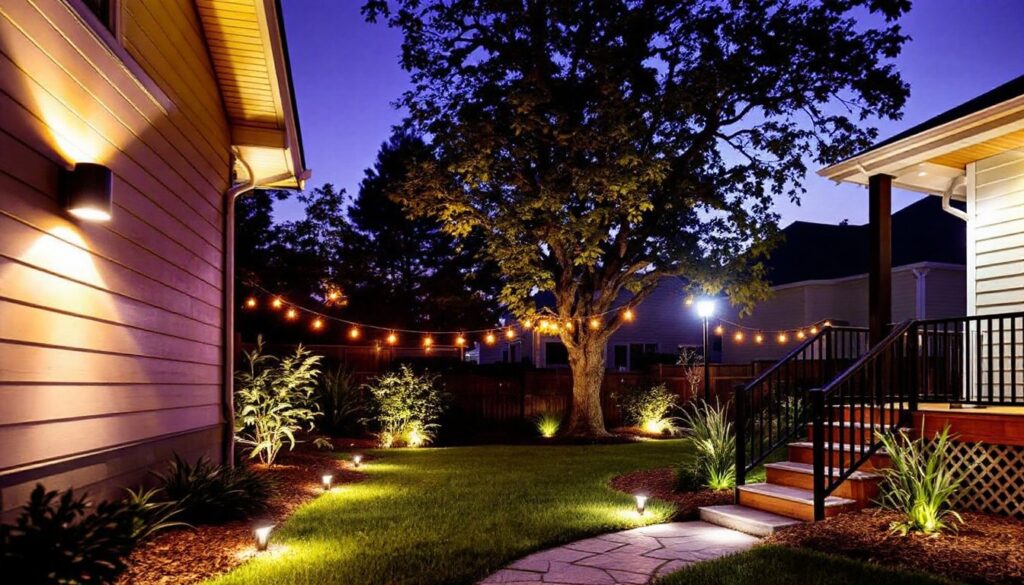
Path lights: Fixtures mounted on stakes, typically 18–24 inches tall, line walkways and driveways. They provide subtle ground-level illumination for safety and wayfinding. Spacing them 6–10 feet apart creates even coverage without light pollution.
Spotlights (up-lights): Adjustable fixtures that highlight trees, architectural details, or focal points like sculptures. Most offer 20°–60° beam spreads. Position them 2–4 feet from the target and angle upward for dramatic effect. Use shielded or hooded models to reduce glare.
Well lights (in-ground lights): Flush-mounted fixtures installed directly in the ground. Ideal for uplighting trees, walls, or columns without visible hardware. Ensure the housing is rated for burial and includes a drainage hole to prevent water accumulation. Outdoor lighting solutions often feature well lights for clean, integrated designs.
Deck and step lights: Low-profile fixtures that mount flush to deck posts, stair risers, or retaining walls. They improve safety on stairs and transitions while adding ambient glow. Choose models with downward-facing lenses to minimize glare.
Hardscape lights: Designed for installation in pavers, stone walls, or concrete. These recessed fixtures withstand foot traffic and weather. They’re perfect for illuminating patios, walkways, or outdoor kitchens.
String lights and area lights: While less common in traditional 12-volt systems, some manufacturers offer low-voltage string lights and hanging fixtures for patios or pergolas. Verify transformer capacity before adding high-wattage area lights.
How to Install 12 Volt Outdoor Lighting (DIY Step-by-Step)
Safety first: Even though 12-volt systems are low-risk, always work with the transformer unplugged. Wear safety glasses when digging or cutting wire. Confirm your outdoor outlet is GFCI-protected.
1. Plan your layout. Map fixture locations on paper or use stakes and string to visualize spacing. Group fixtures into zones if your transformer supports multiple taps. Keep total cable runs under 100 feet per zone to minimize voltage drop.
2. Mount the transformer. Secure it to an exterior wall near a GFCI outlet, ideally 12–18 inches above grade to avoid ground moisture. Use corrosion-resistant screws (typically included). Leave the unit unplugged for now.
3. Run the cable. Unroll low-voltage cable along your planned route. Bury it 6–8 inches deep (check local codes, some jurisdictions require conduit even for low-voltage runs), or tuck it beneath mulch for above-ground installations. Use cable staples to secure runs along fences or deck framing. Avoid sharp bends that stress the wire.
4. Connect fixtures. Most fixtures use quick-connect clips: open the clip, insert the main cable, and close. The clip’s internal teeth pierce the insulation to make contact. Alternatively, strip wire ends and join with wire nuts and waterproof tape. Follow manufacturer instructions, some fixtures require polarity-specific connections (positive/negative).
5. Test the system. Plug in the transformer and turn it on. Walk the circuit to confirm all fixtures light up. Use a multimeter to check voltage at the farthest fixture: it should read at least 10.8 volts (a 10% drop is acceptable). If voltage is lower, upsize your cable gauge or shorten the run.
6. Set timers and adjustments. Program the transformer’s timer or photocell. Aim fixtures to minimize glare and maximize coverage. Adjust stakes or angles as needed.
7. Finish burial and cleanup. Once you’re satisfied, backfill any trenches and compact soil. Mark cable routes on a diagram for future reference, you’ll thank yourself when you dig next spring.
Common pitfall: Voltage drop kills brightness. If distant fixtures glow dimly, either shorten the cable run, increase wire gauge to 10-gauge, or add a second transformer closer to the affected zone.
When to call a pro: If your project requires running new 120-volt circuits to power the transformer, hire a licensed electrician. Structural work, like cutting into hardscape for well lights, may also warrant professional help to avoid costly mistakes.