Table of Contents
ToggleNothing signals the holidays quite like a well-lit home. Christmas outdoor lighting transforms ordinary houses into beacons of seasonal cheer, drawing neighbors out for evening walks and setting the tone for family gatherings. But stringing lights across eaves and bushes isn’t just about aesthetics, it’s a project that demands planning, electrical know-how, and a solid grasp of safety standards. Whether you’re tackling your first display or upgrading a decade-old setup, understanding the options, installation methods, and energy costs will save time, money, and trips up the ladder.
Key Takeaways
- Switching from incandescent to LED Christmas outdoor lighting reduces energy consumption by up to 80% and saves approximately $3.60 per 100-foot strand per season.
- Proper circuit management is essential—calculate total wattage of all fixtures and keep loads below 80% of your circuit’s capacity (1,440 watts for a 15-amp circuit) to prevent breaker trips.
- Use only outdoor-rated extension cords marked with a ‘W’, plastic clips designed for lights, and avoid stapling or nailing directly through light strands to maintain safety and wire integrity.
- Planning outdoor Christmas lighting displays requires measuring rooflines, checking electrical capacity, and considering accessibility before installation to avoid common mistakes and safety hazards.
- Coil strands loosely around storage reels in cool, dry places and perform annual maintenance by cleaning fixtures and checking GFCI outlets to extend the lifespan of your holiday display.
- LED spotlights, icicle lights, and programmable smart systems offer modern alternatives to traditional string lights, with features like dimming, color-changing, and smartphone control for enhanced aesthetics.
Why Outdoor Christmas Lighting Matters for Your Home
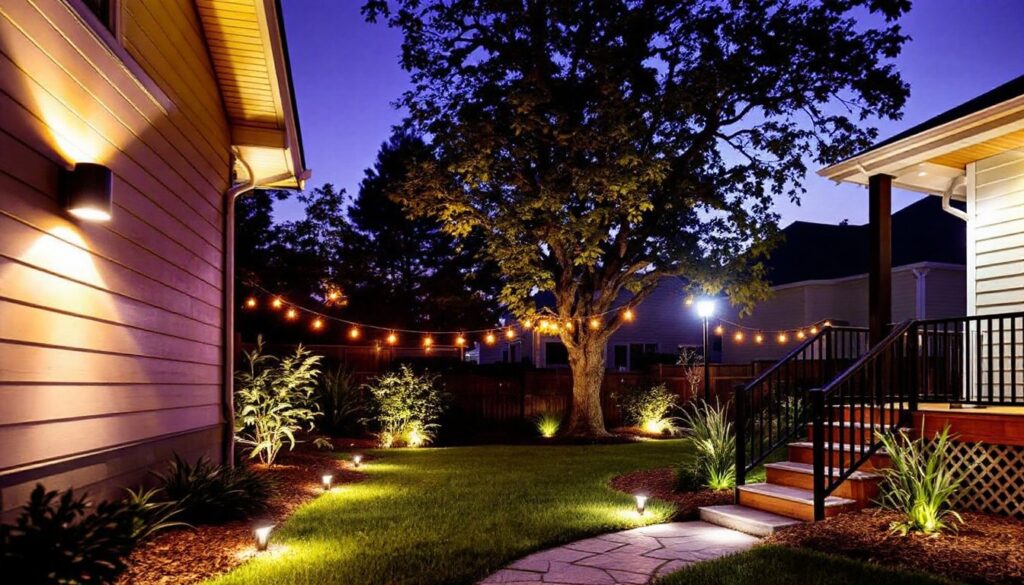
Outdoor lighting does more than announce holiday spirit. A thoughtfully designed display boosts curb appeal, creates a sense of community, and can even improve home security during the darker months. Well-placed lights highlight architectural features, rooflines, columns, entryways, and draw attention to landscaping that might otherwise disappear after sunset.
From a practical standpoint, exterior holiday lighting extends the usable hours of outdoor spaces. Homeowners who invest in quality fixtures and proper installation often find the setup pays dividends beyond December, as many systems can be adapted for year-round accent lighting.
There’s also the social dimension. Neighborhoods with coordinated or enthusiastic light displays tend to see more foot traffic and a stronger sense of connection among residents. For families with young children, a well-lit yard becomes part of the season’s ritual. Just be mindful of local ordinances, some municipalities regulate brightness levels or hours of operation, especially in dense residential areas.
Types of Christmas Outdoor Lights to Consider
String Lights and Icicle Lights
String lights remain the workhorse of holiday displays. Available in incandescent and LED versions, they come in a range of bulb sizes, from classic C7 (about 2 inches tall) and C9 (roughly 3 inches) to smaller mini lights. C7 and C9 bulbs use intermediate (E12) or candelabra (E17) bases, respectively, and are bright enough to outline rooflines or wrap large trees. Mini lights work better for bushes, railings, or detailed trim work.
Incandescent bulbs produce a warm glow but draw more power and generate heat, which can be a concern on wooden structures or near flammable materials. LED bulbs consume up to 80% less energy, run cooler, and last significantly longer, often 25,000 hours or more. Many LED sets also offer programmable features like dimming or color-changing modes.
Icicle lights hang vertically from a horizontal strand, mimicking frozen drips along eaves. They’re effective for creating depth and movement, especially when paired with a gentle breeze. Look for sets with drop lengths that suit your fascia depth, 12 to 18 inches is standard for single-story homes. Avoid overloading circuits: most residential outdoor outlets are on 15-amp breakers, which handle roughly 1,800 watts before tripping.
Spotlights, Projectors, and LED Options
Spotlights and floodlights add drama by uplighting trees, architectural details, or yard ornaments. Low-voltage LED spotlights (typically 12V) are safer and easier to install than line-voltage (120V) models, though they require a transformer. Position them at ground level, angled upward at 30 to 45 degrees for best effect. Stake-mounted fixtures simplify repositioning year to year.
Laser projectors have gained popularity for their ease of use, simply plug in, aim, and let the device cast moving patterns across a facade. But, they’re not universally loved: some neighbors find the effect garish, and the patterns can bleed onto adjacent properties. If you choose a projector, test placement during daylight to ensure coverage stays within your lot lines.
Modern smart outdoor lighting systems integrate with home automation platforms, allowing control via smartphone apps or voice assistants. Features include scheduling, zone control, and color customization. These systems typically use weatherproof controllers rated for outdoor use (look for IP65 or higher ingress protection). Keep in mind that Wi-Fi or Bluetooth range may be limited outdoors, especially in larger yards or areas with metal siding.
Planning Your Outdoor Christmas Lighting Display
Start by sketching your property layout, noting existing outlets, roof peaks, tree locations, and pathways. Measure rooflines, fascia boards, and any features you want to highlight, underestimating strand length is a common rookie mistake. Add 10% to your measurements to account for draping and connections.
Decide on a color scheme and style early. Warm white and multicolor are traditional, while cool white or blue tones create a modern or “icy” aesthetic. Mixing too many styles, say, icicle lights, net lights, and projectors on the same facade, often results in visual clutter rather than cohesion.
Inventory your electrical capacity. Each outdoor outlet should be protected by a ground-fault circuit interrupter (GFCI), which cuts power if moisture or a short is detected. Most GFCI outlets are rated for 15 amps (1,800 watts). Calculate total wattage by adding up all connected fixtures: for LED lights, this is usually printed on the packaging. If your total approaches 80% of the circuit’s capacity (about 1,440 watts for a 15-amp circuit), spread the load across multiple outlets or circuits to prevent nuisance tripping.
Consider accessibility for installation and takedown. If you’ll need a ladder taller than 12 feet, think about renting an extension ladder with standoffs to protect gutters, or hire a pro. Working above single-story height, especially on pitched roofs, significantly increases fall risk. Many areas require fall protection equipment for work above 6 feet under OSHA standards, though residential DIY projects aren’t technically governed by OSHA, local building codes may still apply.
Finally, plan for takedown and storage. Proper maintenance routines extend the life of both bulbs and extension cords. Label strands by location (“front eave,” “oak tree,” etc.) and store them in waterproof bins to prevent tangling and moisture damage.
Installation Tips for Safe and Stunning Results
Safety first. Wear rubber-soled shoes, especially on wet surfaces or dewy mornings. Use a fiberglass or wood ladder, metal conducts electricity. Inspect all cords and bulbs before installation: cracked insulation, exposed wires, or broken sockets are fire hazards. According to common safety mistakes, many homeowners overlook using outdoor-rated extension cords, which are marked with a “W” on the jacket and have thicker insulation to withstand moisture and temperature swings.
Never staple or nail directly through light strands. Use plastic clips designed for holiday lights, shingle tabs for asphalt roofs, gutter hooks for fascia, or adhesive clips for siding. Clips preserve wire integrity and make removal easier. For bushes and trees, wrap strands loosely to allow for growth and wind movement: rigid attachment can stress branches or snap wires.
When connecting multiple strands, don’t exceed the manufacturer’s series limit, typically three to five sets for incandescent lights, up to 25 for LEDs. Exceeding this creates voltage drop, dimming the farthest bulbs and potentially overheating connections. Use outdoor-rated extension cords (14 AWG or heavier for runs over 25 feet) and keep connections off the ground. Elevate them on hooks or wrap in waterproof tape to prevent pooling water from causing shorts.
For modern outdoor decor that extends beyond holiday lights, consider installing permanent mounting points like eye hooks or low-profile clips that remain year-round. This reduces repetitive ladder work and fastener damage to siding or trim.
Test each section as you install it. Climbing down to troubleshoot a dead strand is frustrating: catching a bad bulb or connection on the way up saves time. Carry a voltage tester or a spare bulb to quickly identify issues. If a strand won’t light, check the fuse in the plug, most sets have a small sliding door covering a replaceable 3A or 5A fuse.
Avoid overloading timers or smart plugs. Most mechanical timers are rated for 1,800 watts, but cheaper models may struggle with inductive loads (like motor-driven projectors) or the inrush current of LED drivers. Digital timers and smart plugs generally handle modern lighting better, but always check the device’s wattage rating.
Energy Efficiency and Maintenance Best Practices
Switching from incandescent to LED cuts energy costs dramatically. A 100-foot strand of C9 incandescent bulbs draws about 175 watts: the LED equivalent uses around 20 watts. Over a 30-day season running 6 hours per night, that’s roughly 31.5 kWh versus 3.6 kWh. At $0.13 per kWh (the U.S. average as of late 2025), incandescent costs about $4.10 per strand per season: LED runs just $0.47. Scale that across a whole-house display, and the savings add up fast.
Timers and smart controllers further reduce waste. Set lights to turn on at dusk and off by midnight or 1 a.m., unless you’re in a neighborhood that coordinates later hours. Motion-activated or dusk-to-dawn sensors are overkill for decorative lighting but can work for pathway or security lights integrated into the display.
Maintenance starts with proper storage. Coil strands loosely around a cardboard spool or storage reel, tight winding stresses solder joints. Store in a cool, dry place: attics and garages subject to extreme heat can degrade insulation over time. Before packing away, do a final check for blown bulbs or damaged sockets. Replacing one or two bulbs is easier in January than hunting for failures the following December.
Clean bulbs and fixtures annually. Dirt and oxidation reduce light output by up to 30%. A damp cloth and mild detergent are usually sufficient: avoid abrasive cleaners on plastic lenses. For outdoor lighting fixtures that stay up year-round, consider applying a UV protectant spray to slow plastic yellowing, especially in regions with intense sun.
Check GFCI outlets and extension cord ends for corrosion. Greenish or white buildup indicates moisture intrusion. Replace affected cords and consider using weatherproof cord protectors or junction boxes for connections that must stay outside. If an outlet repeatedly trips, it may be faulty or detecting a real ground fault, don’t bypass it. Call a licensed electrician if troubleshooting doesn’t resolve the issue.
Finally, be realistic about lifespan. Even high-quality LED strands degrade: diodes dim over time, and cheap controllers fail. Budget for replacing 10–15% of your display every few years. Keeping a log of purchase dates and failure points helps identify underperforming brands or installation practices that need adjustment.
By combining smart planning, code-compliant installation, and routine upkeep, a holiday lighting display becomes a manageable, repeatable project, one that brings seasonal joy without the safety risks or energy bills that plague hasty setups.