Table of Contents
TogglePendant lighting does serious heavy lifting in home design, it provides task lighting where you need it, adds visual interest at eye level, and can define spaces without walls. Kichler has been manufacturing residential lighting fixtures since 1938, earning a reputation for durable construction and designs that span from traditional to cutting-edge contemporary. Whether you’re updating a builder-grade kitchen or adding character to a dining room, understanding what sets Kichler pendants apart, and how to select and install them properly, makes the difference between a fixture that works and one that transforms a space.
Key Takeaways
- Kichler pendant lighting combines durable construction with UL-listed components and finishes that resist chipping and corrosion, backed by a 3–5 year warranty and accessible replacement parts.
- Proper sizing and spacing are critical: kitchen islands need pendants spaced 30–36 inches above countertops, dining tables require fixtures 30–34 inches above the surface, and dimensions should proportionally match the space (typically one-third to one-half of the area width).
- Kichler pendants offer versatility across styles—from farmhouse and industrial designs with seeded glass to contemporary options with geometric metalwork—and use standard E26 sockets compatible with incandescent, CFL, or LED bulbs without rewiring.
- Task lighting should deliver 3,000–4,000 lumens total, while ambient lighting requires 1,500–2,500 lumens; shade material (clear glass for task lighting, frosted or opal for diffused light) and color temperature (2700K warm, 3000K neutral, 4000K cool) directly affect performance and ambiance.
- Safe installation requires turning off power at the breaker, testing wires with a voltage tester, verifying the electrical box weight rating, and ensuring proper wire connections with correctly gauged wire nuts—always consult local electrical codes for multi-fixture installations.
Why Choose Kichler Pendant Lighting for Your Home
Kichler builds fixtures with UL-listed components and finishes that hold up to kitchen humidity, bathroom moisture, and high-traffic areas. Their powder-coated metals resist chipping better than spray-painted alternatives, and glass shades are typically hand-blown or molded with thicker walls than budget imports.
Most Kichler pendants use standard E26 medium-base sockets, which means you’re not locked into proprietary bulbs. You can swap between incandescent, CFL, or LED without rewiring. Many newer collections ship with integrated LED arrays rated for 50,000+ hours, which translates to roughly 25 years at six hours of daily use.
Kichler’s warranty coverage runs three to five years depending on the collection, and their customer service stocks replacement glass, canopies, and cord kits. That matters when a shade breaks or you want to adjust the drop length five years down the road. Many off-brand fixtures require complete replacement for a cracked diffuser.
From a design standpoint, Kichler releases seasonal collections that track current trends without looking dated in three years. Their in-house design team collaborates with architects and interior designers to ensure proportions work in real rooms, not just showroom vignettes.
Popular Kichler Pendant Lighting Styles and Collections
Farmhouse and Industrial Designs
The Barrington collection features distressed wood and seeded glass, a combination that softens industrial cage frames. The wood is actual kiln-dried hardwood with a weathered zinc finish on the metal, not printed laminate. These run 12–14 inches in diameter and work over kitchen islands when hung in pairs or trios.
Armadillo pendants use galvanized metal with an aged patina and Edison-style bulbs (not included). The exposed socket design means bulb choice affects the entire look, go with clear glass vintage LEDs for authenticity or frosted for softer light. The single-pendant version measures roughly 17 inches wide and drops 13 inches from canopy to bottom of shade, suitable for 8- to 9-foot ceilings.
For true industrial looks, the Saybridge line uses oil-rubbed bronze or brushed nickel with clear seeded glass. The seeding is subtle, more texture than distortion, so it doesn’t interfere with task lighting. These are popular for modern lighting upgrades in renovated lofts or basement bars.
Modern and Contemporary Options
The Everly collection combines geometric metalwork with etched opal glass, creating diffused light without glare. The frames use satin nickel or chrome plating, and the opal glass is a triple-layer laminate that stays cooler to the touch than single-layer alternatives. Sizes range from 8-inch mini pendants to 20-inch statement pieces.
Tori pendants feature sleek cylindrical or dome shades in clear or smoked glass with visible filament LEDs. The minimalist canopy measures just 5 inches in diameter, which makes ceiling installation cleaner on older plaster ceilings with limited joist access. Homeowners drawn to vintage-inspired aesthetics often pair these with Edison bulbs for a retro-modern hybrid.
Kichler’s Granby line takes mid-century cues with black or aged brass finishes and clear glass globes. The globes are 10 inches in diameter, large enough to make a statement but not so big they overwhelm a breakfast nook. Cord lengths are adjustable from 10 to 60 inches, giving flexibility for vaulted or standard ceilings.
Where to Install Kichler Pendant Lights in Your Home
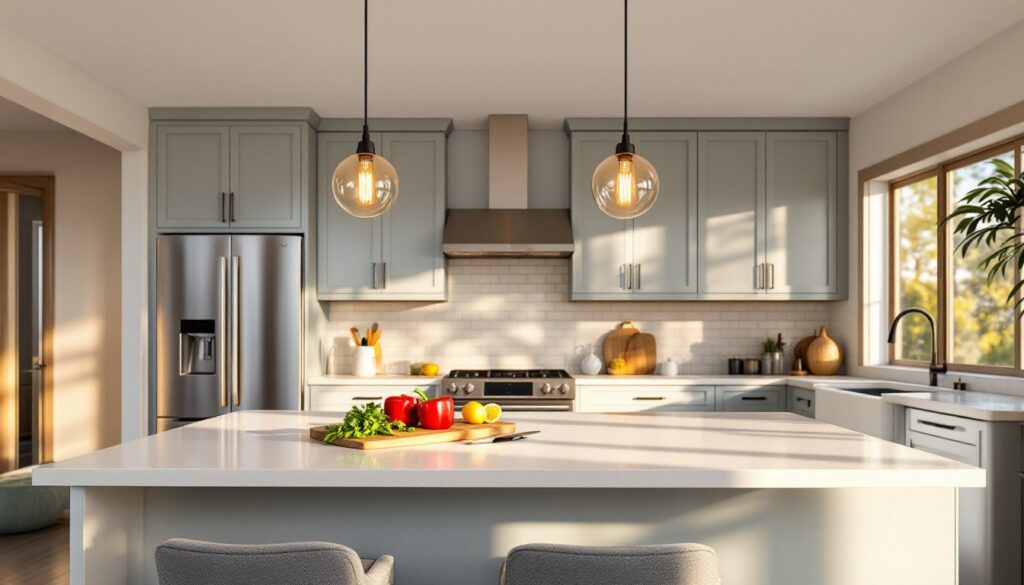
Kitchen islands are the most common application. Hang pendants 30–36 inches above the countertop for task lighting without head-bumping. For an island that’s 6 feet long, use two 12- to 14-inch pendants spaced evenly. An 8-foot island can handle three pendants or two larger 16- to 18-inch fixtures. Measure from the center of the island, not the edge, to find your spacing.
Dining tables benefit from a single large pendant or a linear multi-light fixture. The bottom of the shade should sit 30–34 inches above the table surface. If your table is expandable, center the fixture over the table at its most common length, not fully extended. A dimmer switch (compatible with LED bulbs if that’s your choice) lets you shift from task lighting during meals to ambient lighting afterward.
Bathroom vanities work well with pendants flanking a mirror, but check local electrical codes, many jurisdictions require fixtures within certain distances of water sources to be rated for damp or wet locations. Kichler’s damp-rated pendants have sealed sockets and corrosion-resistant hardware. Hang them 18–20 inches out from the wall and 60–65 inches from the floor for even face lighting.
Entryways and stairwells need fixtures that scale to the ceiling height. For a two-story foyer with a 16- to 18-foot ceiling, a pendant with a 50- to 60-inch overall drop (including cord and canopy) creates visual balance. Make sure the bottom of the fixture clears head height, typically 6 feet 8 inches minimum, on staircases.
Bedroom nightstands can use mini pendants in place of table lamps, freeing up surface space. Mount the electrical box 18–24 inches above the nightstand and use a pendant with a fabric or opaque shade to avoid glare when reading. This often requires running new wiring inside the wall, which may need a permit depending on your jurisdiction.
How to Choose the Right Kichler Pendant for Your Space
Start with bulb type and lumens. For task lighting over a kitchen island, aim for 3,000–4,000 lumens total (spread across multiple pendants). For ambient or accent lighting, 1,500–2,500 lumens works. If you’re using integrated LEDs, check the color temperature, 2700K gives a warm, incandescent-like glow, while 3000K is neutral white and 4000K leans cool and clinical.
Next, consider shade material and light distribution. Clear glass directs light downward with minimal diffusion, ideal for task areas. Frosted or opal glass spreads light in all directions, better for ambient lighting. Metal shades (like in industrial designs) create dramatic downward beams but may need supplemental lighting for overall room brightness.
Proportions matter. A pendant that’s too small looks like an afterthought: too large overwhelms the space. For kitchen islands, the combined width of all pendants should equal roughly one-third to one-half the island length. Over a dining table, a single pendant should be one-half to two-thirds the table width. Designers and architects often use these ratios when planning ceiling light layouts for balanced illumination.
Finish selection should complement existing hardware, cabinet pulls, faucets, door handles. Kichler offers brushed nickel, oil-rubbed bronze, black, aged brass, and chrome. Mixed metals can work (black pendants with brass faucets, for example), but keep undertones consistent, warm metals with warm, cool with cool.
Check the ceiling canopy diameter. Standard canopies are 5 inches, which covers most electrical boxes. If you’re replacing an older fixture with a larger canopy footprint, you may need to patch and repaint the ceiling. Some Kichler pendants offer swivel canopies for sloped ceilings up to a 45-degree pitch, verify compatibility if you’re installing on a vaulted ceiling.
Installation Tips for Kichler Pendant Lighting
Turn off power at the breaker, not just the wall switch. Use a non-contact voltage tester on the wires in the electrical box before touching anything. This is a non-negotiable safety step.
Most Kichler pendants ship with a mounting bar that screws into the electrical box. Verify your box is rated for the fixture weight, some pendants exceed the 50-pound limit of plastic retrofit boxes. If you’re installing a heavy multi-light pendant or a large glass globe, you may need to replace the box with a metal pancake box screwed directly to a ceiling joist or install a fan-rated box with a brace bar between joists.
Cord or rod length is usually adjustable. Kichler pendants with fabric-covered cord can be shortened by coiling excess inside the canopy (don’t cut the cord, it voids the UL listing). Pendants with rigid downrods or chains can be shortened by removing links or cutting the rod with a hacksaw, then filing the burr smooth. Wear safety glasses when cutting metal.
Wiring is straightforward: black (hot) to black, white (neutral) to white, bare copper (ground) to green or bare copper. Use wire nuts rated for the wire gauge (typically 14 AWG for lighting circuits). Twist wires clockwise before threading the nut on, then tug each wire to confirm a solid connection. Some Kichler fixtures include a quick-connect wiring block, follow the color-coded diagram in the instruction sheet.
If you’re installing multiple pendants on the same circuit, you can wire them in parallel (each pendant gets its own hot, neutral, and ground connection at the junction box) or daisy-chain them (running cable from one pendant to the next). Daisy-chaining reduces the number of home runs back to the switch but requires fishing wire through the ceiling, which is easier before drywall goes up. For existing ceilings, parallel wiring with individual boxes is simpler but may require more electrical boxes. Always check your local electrical code, some jurisdictions have specific requirements for multi-fixture installations.
After installation, install the bulbs (following the fixture’s wattage and bulb type limits) and restore power. Test the switch and inspect for flickering or buzzing. LED bulbs can hum if they’re incompatible with older dimmer switches, replace the dimmer with an LED-compatible model if needed. Most big-box stores stock Lutron and Leviton LED dimmers that work with 90% of fixtures.
Clean glass shades with a microfiber cloth and glass cleaner after installation. Oils from your hands during assembly can leave smudges that become visible once the light is on.