Table of Contents
ToggleStringing up thousands of holiday lights or installing complex landscape lighting systems used to mean hours on a ladder, tangled extension cords, and a power bill that made homeowners wince. Laser outdoor lighting changed that equation. These compact projectors cast moving or static patterns across your home’s facade, trees, and yard in minutes, no staple gun required. They’ve evolved from novelty gadgets into serious alternatives for both seasonal displays and year-round accent lighting, with weather-resistant housings and programmable timers that make traditional string lights look downright antiquated.
Key Takeaways
- Laser outdoor lighting installs in minutes without ladders or tangled cords, covering 2,000+ square feet compared to hours needed for traditional string lights.
- These projectors use laser diodes to cast patterns up to 200 feet away while drawing only 5–15 watts, reducing energy costs by approximately $5–$8 per season.
- Laser outdoor lighting offers durability with 20,000+ hour-rated diodes, no filaments to break, and weather-resistant housings that eliminate fire risk from dry foliage contact.
- Multi-pattern rotating units ($60–$120) and smart-enabled models provide versatility for seasonal decorating, from holiday displays to year-round landscaping accents without storage clutter.
- Proper safety requires GFCI-protected outlets, avoiding direct beam exposure to eyes or aircraft, and respecting local ordinances about light trespass on neighboring properties.
- Creative applications include accentuating tree canopies, illuminating water features, highlighting architectural details, and hosting event lighting with zero permanent installation.
What Is Laser Outdoor Lighting and How Does It Work?
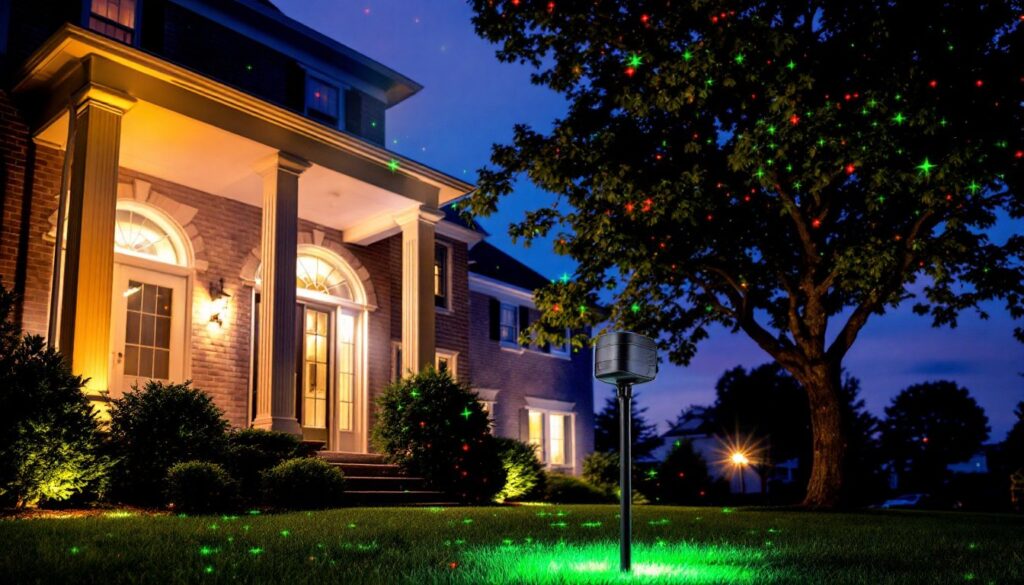
A laser outdoor light is a ground-mounted or stake-mounted projector that uses laser diodes to cast patterns, dots, stars, lines, or moving effects, across surfaces up to 200 feet away, depending on the model’s power output. Unlike traditional bulbs or LEDs that emit light in all directions, laser units focus coherent light beams through patterned lenses or diffraction gratings to create specific shapes.
Most residential units combine red and green lasers (the most common wavelengths for outdoor use) or add blue for multi-color effects. The housing contains the laser module, lens assembly, motor (for moving effects), and a weather-resistant enclosure rated IP65 or higher to handle rain, snow, and freezing temperatures. A standard 120V plug powers the unit, though some models include low-voltage transformers for safer outdoor runs.
The tech is simpler than it sounds. Point the unit at your target surface, adjust the angle with the mounting stake or bracket, and plug it in. Internal motors rotate the lens or mirror assembly to create motion, while a timer chip cycles the unit on and off. No wiring individual bulbs, no climbing to hang strands, no replacing burned-out sockets mid-season.
Benefits of Choosing Laser Lights for Your Outdoor Spaces
Installation time: Five minutes versus five hours. That’s the practical difference. One homeowner can stake a laser unit into the ground, aim it, and cover a 2,000-square-foot facade in the time it takes to untangle a single strand of incandescents.
Energy consumption: Laser units draw between 5 and 15 watts, roughly the same as a single LED bulb. A typical 300-count string of mini lights pulls 72 watts. Run both nightly from Thanksgiving to New Year’s, and the laser saves about 50 kWh, which translates to $5–$8 in most regions. Modest, but it adds up if you’re lighting multiple areas.
Durability: No filaments to break, no glass bulbs to shatter. The laser diodes in quality units are rated for 20,000+ hours of operation. That’s roughly 20 holiday seasons at six hours per night. Weather seals prevent moisture intrusion, and the lack of heat buildup (lasers run cool) eliminates fire risk from contact with dry foliage.
Versatility: The same unit that projects snowflakes in December can throw subtle dots across landscaping beds in July. Swap patterns with interchangeable lens caps, adjust speed and color modes, and reposition the projector as your yard evolves. No storage bins full of tangled wires.
Those who prioritize proper lighting maintenance appreciate the low upkeep. Wipe the lens occasionally, check the ground stake for frost heave in spring, and you’re done.
Types of Laser Outdoor Lighting Systems Available
Single-pattern static projectors: The entry-level option. One fixed pattern (usually red and green dots or stars) with no motion. Best for broad coverage on a budget, think $30–$60. Coverage area typically spans 1,500–2,500 square feet at 30 feet distance.
Multi-pattern rotating units: These include interchangeable lens caps or internal selectors for 5–12 different patterns (snowflakes, stars, geometric shapes). Built-in motors add motion, slow drift, twinkling, or cascading effects. Expect to pay $60–$120. They’re the sweet spot for homeowners who want variety without complexity.
Smart-enabled laser lights: Wi-Fi or Bluetooth connectivity allows smartphone control of color, speed, timer schedules, and pattern selection. Some integrate with voice assistants or home automation platforms. Price range: $100–$200. Worth it if you’re already running a smart home ecosystem and want to trigger lighting scenes or sync with other outdoor fixtures.
RGB full-color lasers: Beyond basic red-green combos, these add blue and sometimes white diodes for a broader spectrum. They project full-color images or blend hues for gradient effects. Commercial-grade units start around $150 and climb past $300 for high-output models that can light large trees or multi-story buildings.
Recent reviews on Tom’s Guide have highlighted smart models for their convenience, though basic rotating units still dominate holiday sales for reliability and value.
How to Install Laser Outdoor Lights: A Step-by-Step Guide
Tools and materials:
- Laser projector unit with ground stake or mounting bracket
- Outdoor-rated extension cord (14-gauge minimum for runs over 25 feet)
- GFCI-protected outlet or portable GFCI adapter
- Tape measure
- Small level (optional, for precise horizontal alignment)
- Timer or smart plug (if not built into the unit)
Step 1: Choose your projection surface and desired coverage area. Measure the distance from your planned projector location to the target, most units spec coverage at 20–30 feet. Position the unit 15–25 feet back from the surface for sharpest focus.
Step 2: Drive the ground stake into soil at a 90-degree angle, ensuring the projector head sits 8–12 inches above grade to avoid snow burial or lawn mower contact. For hard surfaces (decks, patios), use the mounting bracket and corrosion-resistant screws (usually stainless steel or coated deck screws).
Step 3: Aim the unit at your target and power it on. Adjust the angle, most stakes have ball joints or tilt brackets. Start centered, then pan left or right to expand coverage. If the pattern looks elongated or blurry, move the projector closer or farther until edges sharpen.
Step 4: Route the power cord along the ground, securing it with landscape staples (not regular staples, those corrode). Keep cords out of walkways and mowing paths. Plug into a GFCI outlet. If your exterior outlets lack GFCI protection, use a portable GFCI adapter, it’s a $15 safety measure that prevents shock in wet conditions.
Step 5: Set your timer. Built-in timers usually offer 2-, 4-, 6-, or 8-hour cycles. For units without timers, add an outdoor-rated mechanical or digital timer to the outlet. Dusk-to-dawn settings work, but fixed durations save more energy.
Permit note: Laser projectors don’t alter structures or electrical systems, so permits aren’t typically required. But, check local ordinances about light trespass, some HOAs or municipalities restrict colored lights visible from streets or neighboring properties.
Safety Considerations and Best Practices
Eye safety: Residential laser units are classified as Class 2 or Class 3R under FDA and IEC standards, meaning direct eye exposure at close range can cause temporary flash blindness or afterimages. Never stare into the aperture or point the unit at people, vehicles, or aircraft. The beams diffuse rapidly over distance, by the time they hit your house at 20 feet, power density is low enough to be safe, but proximity matters.
Electrical safety: Always use GFCI protection. Moisture on a standard outlet can create ground faults that trip breakers or, worse, cause shock. Ensure extension cords are rated for outdoor use (look for the “W” designation: SJTW, SJTOW). Avoid daisy-chaining multiple cords or overloading a single circuit with other high-draw devices.
Weather exposure: IP65-rated housings handle rain and snow, but ice buildup on the lens can block or distort patterns. Position units under eaves or in sheltered spots if possible. After heavy snow, brush off the lens and check that vents (if present) aren’t blocked, some units vent heat from motor assemblies.
Light trespass: Aim projectors at your own property. Casting patterns onto neighbors’ windows, driveways, or passing traffic isn’t just rude, it can violate local nuisance ordinances. Adjust angles and use barriers (fences, hedges) to contain the display.
Wildlife: Bright, moving lights can disorient nocturnal animals or migrating birds. If you live near wildlife corridors or migration paths, limit run times to early evening hours (before 10 PM) and avoid aiming at tree canopies during spring and fall migrations.
Creative Ways to Use Laser Lighting in Your Yard
Accent mature trees: Position a green laser at the base of a large oak or maple and let the dots climb the trunk and canopy. It mimics fireflies in summer or adds subtle texture to winter branches without the hassle of wrapping strands around limbs.
Pathway lighting: Use a low-intensity unit to cast a gentle pattern across walkways or stepping stones. Pair with traditional outdoor house decor elements like lanterns or planters for a layered look. The motion effect guides guests without harsh spotlights.
Water features: Project onto fountains, ponds, or pool surfaces for shimmering reflections. The light doesn’t need to be waterproof, just the housing. Place the unit on the deck or patio edge and aim across the water. Movement patterns amplify ripples and waves.
Seasonal transitions: Swap lens caps to match holidays, red and green for Christmas, orange for Halloween, red and pink for Valentine’s Day, red-white-blue for summer. One unit, multiple uses, zero redecorating.
Architectural highlighting: Angle a unit upward to graze brick facades, stone veneer, or textured siding. The shadows and highlights bring out material depth, similar to how uplighting works in LED landscape designs. Reports from Digital Trends note this technique is growing in smart home setups for automated ambiance.
Event lighting: Temporary installations for parties, weddings, or outdoor gatherings. Stake units around a patio or tent perimeter, sync timers, and remove them the next day. No permanent fixtures, no electrician bills.
For those comfortable with tools, guides on Popular Mechanics cover mounting lasers to pergolas or fences for elevated projection angles that reduce ground shadows.
Conclusion
Laser outdoor lighting won’t replace every application of traditional fixtures, uplights, path lights, and security floods still have their place. But for broad-area decoration, seasonal displays, and low-maintenance accent work, they’re hard to beat. The combination of fast setup, minimal power draw, and multi-season flexibility makes them a practical addition to any homeowner’s lighting toolkit. Choose a unit that matches your coverage area and feature needs, follow basic electrical safety, and you’ll have a reliable system that takes minutes to deploy and years to wear out.