Table of Contents
ToggleCommercial properties don’t sleep, they work 24/7, and their exterior lighting needs to keep pace. Whether you’re illuminating a parking lot at 2 a.m. or showcasing an architectural gem after dark, outdoor lighting isn’t just about flipping a switch. It’s about security, energy efficiency, code compliance, and making sure customers can actually find your front door. This guide breaks down the fixture types, installation realities, and maintenance protocols that separate functional commercial lighting from expensive guesswork.
Key Takeaways
- Outdoor lighting commercial properties is essential for security, legal compliance, and customer perception, with municipalities typically enforcing minimum footcandle requirements of 1–5 depending on zoning.
- Upgrading from 400-watt metal halide fixtures to LED solutions can reduce energy consumption by 60–75%, with payback periods often under three years for high-use facilities.
- Choose fixture types based on specific site needs: area lights and shoebox fixtures for parking lots, wall packs for entryways, and uplights for architectural accent lighting.
- Commercial outdoor lighting fixtures require IP65 ratings minimum, quality LEDs delivering 100–150 lumens per watt, and proper grounding to meet NEC Article 250 safety standards.
- Professional installation by licensed electricians, proper wiring through Schedule 40/80 PVC conduit, and quarterly maintenance of lenses and gaskets ensure long-term performance and compliance.
- Invest in dimmable LED systems with DALI control or photocell compatibility to automate scheduling, extend fixture life, and maximize energy savings across your commercial property.
Why Commercial Outdoor Lighting Matters for Your Business
Visibility after sundown isn’t optional for commercial properties, it’s a legal and liability issue. Poorly lit parking areas increase slip-and-fall claims, while dark building perimeters invite trespassing and vandalism. Many municipalities enforce minimum footcandle requirements (a measure of light intensity) for parking lots and walkways, typically ranging from 1–5 footcandles depending on zoning.
Beyond compliance, lighting shapes customer perception. A well-lit storefront signals professionalism and safety, while dim or flickering fixtures suggest neglect. According to data on smart outdoor systems, businesses investing in modern lighting upgrades report improved customer dwell time and higher evening traffic.
Energy costs add up fast. A typical 400-watt metal halide fixture running 12 hours a night consumes roughly 175 kWh per month. Multiply that across 20 fixtures, and you’re looking at 3,500 kWh monthly, before you factor in HVAC loads from heat output. Upgrading to LED fixtures can cut that draw by 60–75%, with payback periods often under three years in high-use environments.
Finally, there’s curb appeal. Architectural lighting can highlight building features, signage, and landscaping, differentiating your property from the beige box next door. Just make sure any accent lighting doesn’t create glare or light trespass onto neighboring parcels, local ordinances often cap lumens per square foot for this reason.
Types of Outdoor Lighting for Commercial Properties
Choosing fixtures isn’t about browsing a catalog, it’s about matching light distribution, mounting height, and durability to specific site conditions.
Security and Parking Lot Lighting
Area lights and shoebox fixtures dominate parking lots. These mount on poles (typically 15–30 feet tall) and use Type III or Type IV light distributions to cast rectangular or square patterns. Type III works for perimeter rows: Type IV floods large open areas.
Key specs to check:
- Lumen output: 10,000–30,000 lumens per fixture for standard lots. Larger facilities may need 40,000+ lumens.
- Color temperature: 4000K–5000K (neutral to cool white) enhances visibility and security camera performance.
- IP rating: Look for IP65 or higher to handle rain, dust, and temperature swings.
- Photocell compatibility: Auto on/off at dusk/dawn saves energy and eliminates manual switching.
Wall packs mount directly to building exteriors for entryways, loading docks, and side doors. They’re simpler to install than pole lights (no trenching for electrical runs if you can tap existing circuits), but coverage is limited to roughly 20–30 feet depending on wattage. Choose full-cutoff designs to minimize upward light spill and comply with dark-sky ordinances.
Motion-sensor floods make sense for low-traffic zones like storage yards or after-hours access points. Pair them with dusk-to-dawn photocells so they’re armed only when needed. Just be aware: frequent cycling shortens fixture life, especially with older HID (high-intensity discharge) lamps. LED versions handle it better.
Safety note: Any pole-mounted fixture requires a stable base. Most installers pour a concrete footing at least 3 feet deep (deeper in frost-prone regions) and use galvanized or powder-coated poles rated for local wind loads. Cutting corners here means tilted poles or, worse, fixtures crashing down in a storm.
Architectural and Accent Lighting
Uplights and wall grazers highlight facades, columns, and signage. These are typically low-voltage (12V or 24V) or line-voltage LED fixtures with narrow beam angles (10°–40°). Install them at least 18–24 inches from the building to avoid hot spots and uneven washes.
For textured surfaces (stone, brick), use a grazing angle, mount fixtures close to the wall so light skims across, emphasizing depth. Smooth surfaces like stucco or painted panels look better with washing, fixtures set farther back to create even coverage.
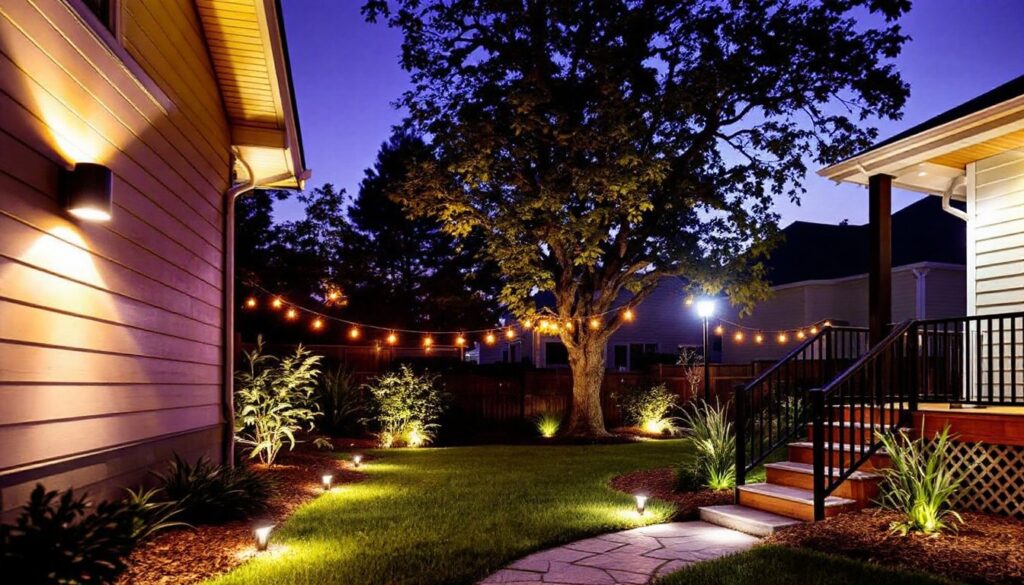
Path and bollard lights define walkways and landscape borders. Bollards should stand 24–42 inches tall and space 15–20 feet apart for continuous visibility. Look for powder-coated aluminum or stainless steel housings: plastic bollards crack under UV exposure and freeze-thaw cycles.
String lights and decorative pendants work for hospitality settings (restaurants, breweries, event spaces), but they’re not structural lighting. Treat them as ambiance, not code-required illumination. Many areas of residential outdoor decor overlap with commercial applications, especially for patios and outdoor dining.
Regardless of type, always check lumens per watt (efficacy). Quality commercial LEDs deliver 100–150 lm/W. Anything under 80 lm/W is outdated tech or budget-grade junk.
Key Features to Look for in Commercial Outdoor Lighting
Not all fixtures are built for the punishment commercial sites dish out. Here’s what separates contractor-grade gear from big-box impulse buys.
Durability and IP ratings: IP65 means dust-tight and protected against water jets, fine for most climates. Coastal or industrial zones? Step up to IP66 or IP67 for high-pressure washdowns and temporary submersion. Die-cast aluminum housings outlast stamped steel: check for impact ratings (IK08 or higher) if vandalism is a concern.
Dimming and controls: Many commercial LED lighting systems support 0–10V dimming or DALI (Digital Addressable Lighting Interface) for centralized control. This lets you schedule output (full brightness at peak hours, 50% overnight) and extend fixture life. Smart systems can integrate with occupancy sensors or daylight harvesting, though they add upfront cost and require network infrastructure.
Color Rendering Index (CRI): For accent and architectural lighting, aim for CRI 80+. It makes colors look natural, critical for retail exteriors, signage, and landscaping. Security lighting can get away with CRI 70: you’re prioritizing lumens and coverage, not aesthetics.
Warranty and serviceability: Commercial fixtures should carry 5–10 year warranties on both LEDs and drivers. Check whether the driver (the electronic component that regulates power) is replaceable. Integrated designs are cheaper upfront but turn the whole fixture into e-waste if the driver fails. Modular designs let you swap drivers in 15 minutes.
Photometric data: Legitimate manufacturers provide IES files, digital maps showing exactly how light spreads. Your electrician or lighting designer can import these into layout software to ensure you’re not over- or under-lighting zones. Guessing fixture count and placement is how you end up with dark corners and wasted energy.
Compliance: Look for UL or ETL listing (safety testing), DLC Premium (energy efficiency), and FCC Part 15 (limits electromagnetic interference). Some rebate programs require DLC-listed products, so don’t skip this if you’re chasing utility incentives.
Installation and Maintenance Best Practices
Commercial outdoor lighting isn’t a weekend DIY project, it involves electrical permits, trenching, and overhead work. Most jurisdictions require a licensed electrician for line-voltage (120V/277V) installations. Even low-voltage systems often need permits if they’re part of new construction or a major retrofit.
Site prep: Walk the property at night to identify existing problem areas, unlit corners, glare from neighboring properties, or spots where light trespass annoys residents. Measure mounting heights and pole spacing with a laser distance meter: eyeballing it leads to uneven coverage.
Wiring and conduit: Outdoor circuits typically run through Schedule 40 or Schedule 80 PVC conduit buried 18–24 inches deep (check local code, some areas require deeper burial or metal conduit). Use THWN-2 or XHHW-2 wire, rated for wet locations. Oversized conduit (e.g., 1-inch instead of ¾-inch) makes future upgrades easier.
For pole lights, the electrician will:
- Pour the concrete base and set anchor bolts.
- Run conduit from the building or nearest junction box to the pole location.
- Install the pole once concrete cures (typically 48–72 hours).
- Mount the fixture, pull wire, and make connections inside the pole base.
- Seal all entry points with weatherproof gaskets and silicone.
Grounding is non-negotiable. Metal poles and fixtures must bond to the building’s grounding system per NEC Article 250. Skipping this invites shock hazards and lightning damage.
Photocell and timer setup: Mount photocells on north-facing surfaces (or where they won’t catch direct sun/light from other fixtures). Test them by covering the sensor with your hand, fixture should power on. For timers or smart controls, integrate them at the panel or use a contactor if you’re switching multiple high-wattage circuits.
Maintenance checklist:
- Quarterly: Inspect lenses for cracks, gaskets for dry rot, and mounting hardware for corrosion. Clean lenses with mild soap and water, not solvents, which can cloud polycarbonate.
- Annually: Check photocells, replace if fixtures won’t turn on/off reliably. Test dimming and control systems.
- Every 3–5 years: Expect to replace drivers in budget fixtures: premium LEDs often last 10+ years.
Keep a log of outages. If one fixture on a circuit fails, it’s the fixture. If a whole run goes dark, check the breaker, contactor, or photocell. For comprehensive strategies on extending fixture life, revisit proven lighting maintenance protocols.
Safety gear: Always use a bucket lift or scaffolding for pole-mounted fixtures, ladders are unstable on asphalt and gravel. Wear insulated gloves and arc-rated PPE if working on live circuits (though best practice is to kill power at the breaker). Some property owners find inspiration in curated guides like those on Gardenista’s outdoor lighting collection, though those lean residential, commercial installs demand heavier-duty specs.
Conclusion
Commercial outdoor lighting isn’t plug-and-play, but it’s also not mysterious. Match fixture types to site needs, respect code and safety requirements, and plan for long-term maintenance. The upfront assignments, photometric layouts, proper wiring, quality components, pays off in lower energy bills, fewer service calls, and a property that actually looks open for business after dark.