Table of Contents
ToggleFour-inch recessed lighting has become the go-to choice for homeowners tackling kitchen remodels, bathroom updates, and whole-home lighting upgrades. These compact fixtures deliver targeted illumination without the visual clutter of pendant lights or the space demands of larger cans. They’re particularly useful in rooms with lower ceilings, typically 8 feet or less, where 6-inch fixtures can look oversized and out of proportion. Whether retrofitting an existing ceiling or wiring new construction, understanding the differences between housing types, trim options, and installation requirements will save time, money, and potential code violations down the road.
Key Takeaways
- 4 inch recessed lighting is ideal for rooms with lower ceilings and spaces where larger 6-inch fixtures won’t fit, making it a versatile choice for kitchens, bathrooms, and hallways.
- IC-rated housings must be used in insulated ceilings to prevent fire hazards and code violations, while non-IC fixtures require a 3-inch clearance from insulation and are only suitable for uninsulated spaces.
- Modern LED technology makes 4 inch recessed lights highly efficient, producing 600–900 lumens with minimal heat generation, allowing for flexible placement and reduced power consumption compared to older incandescent options.
- Proper installation requires careful circuit load calculation, correct housing selection (new construction vs. remodel), and adherence to NEC clearance requirements—testing before closing walls prevents costly troubleshooting later.
- Spacing fixtures 4–6 feet apart with consistent color temperature (2700K–3000K for living areas, 3500K–4000K for task areas) ensures even illumination and a cohesive aesthetic throughout the home.
What Is 4 Inch Recessed Lighting and Why It’s Popular
A 4-inch recessed light (also called a can light or downlight) consists of a cylindrical housing installed above the ceiling and a visible trim piece that sits flush with the ceiling surface. The “4 inch” designation refers to the diameter of the trim opening, not the housing itself, the actual housing is larger to accommodate wiring, the lamp socket, and thermal clearances.
These fixtures gained traction in residential applications for several practical reasons. First, they work in spaces where larger fixtures won’t fit. Joists in older homes are often spaced 16 inches on center, and squeezing multiple 6-inch cans into a narrow hallway or closet creates awkward spacing. Four-inch units fit more easily between framing members and allow tighter layout patterns.
Second, LED technology made small-aperture lighting viable. Older incandescent and halogen recessed lights needed larger housings to dissipate heat. Modern LED retrofit kits and integrated LED housings generate far less heat, so a 4-inch fixture can produce 600–800 lumens, enough for task lighting in kitchens, accent lighting in living rooms, or general illumination in bathrooms, without overheating.
Third, they’re less visually dominant. In rooms with multiple light sources, under-cabinet LEDs, pendants, or sconces, 4-inch recessed lights provide fill lighting without competing for attention. They’re also popular in contemporary and minimalist interiors where clean ceiling lines matter.
Types of 4 Inch Recessed Lights for Your Home
Not all 4-inch recessed lights are interchangeable. The housing, trim, and lamp type must match the application, and choosing the wrong combination can create safety hazards or code violations.
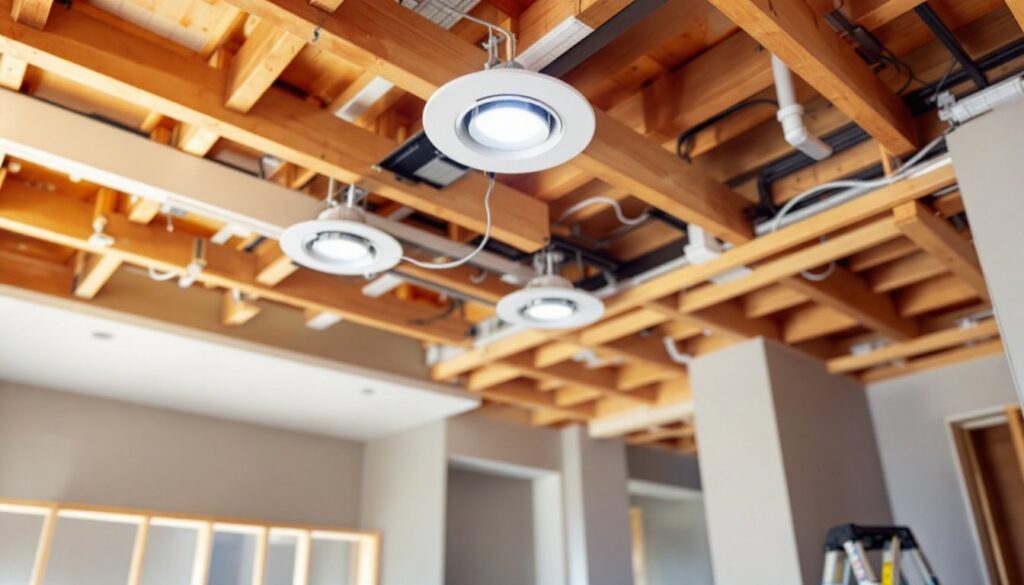
New construction housings are designed for installation before drywall goes up. They include adjustable brackets that nail or screw directly to ceiling joists. These are the most secure and allow precise alignment, but they require ceiling access from above.
Remodel (retrofit) housings are built for finished ceilings. They use spring clips or friction wings that grip the drywall from below. Installation is faster and doesn’t require attic access, but the housing must be self-supporting, some jurisdictions require additional blocking for fire safety.
Integrated LED housings have the light source built into the unit. The entire fixture is replaced when the LEDs eventually fail (typically after 25,000–50,000 hours). These often include selectable color temperature switches (2700K, 3000K, 4000K, 5000K) and are popular for their slim profile.
Retrofit LED kits convert existing recessed cans into LED fixtures. A threaded adapter screws into the old socket, and the new LED module snaps or twists into place. This is the most cost-effective upgrade path if the existing housing is in good shape.
IC-Rated vs. Non-IC-Rated Housings
IC-rated housings (Insulation Contact) are approved for direct contact with ceiling insulation. They include a double-wall construction and thermal cutoff switches that prevent overheating. Any fixture installed in an insulated ceiling, most exterior ceilings and second-floor rooms, must be IC-rated. Installing a non-IC fixture in an insulated ceiling is a code violation and a fire risk.
Non-IC-rated housings require a 3-inch clearance from insulation on all sides. They’re lighter and less expensive but only suitable for uninsulated ceilings like garages, covered porches, or first-floor ceilings with unconditioned crawlspaces below. If there’s any doubt about insulation contact, default to IC-rated, it’s always the safer choice.
Where to Use 4 Inch Recessed Lighting in Your Home
Four-inch recessed lights excel in spaces where focused, unobtrusive lighting is needed. Here’s where they make the most sense:
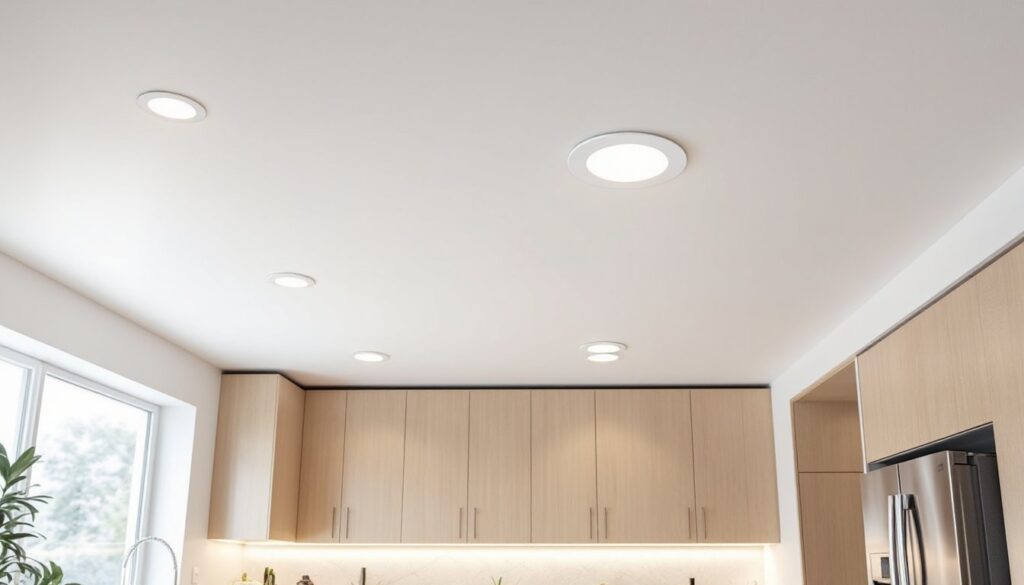
Kitchens: Use them over countertops for task lighting, spaced 24–30 inches apart. Pair them with under-cabinet lighting for layered illumination. Avoid placing them directly over the center of the room if there’s an island or dining table, pendants or a chandelier work better there.
Bathrooms: Position 4-inch cans over vanities, showers, and tubs. For shower installations, the housing must be wet-rated or shower-rated and have a sealed lens trim. Standard housings will fail in damp environments and may not pass inspection.
Hallways and entryways: Space fixtures 4–6 feet apart in narrow corridors. The smaller aperture prevents an “airport runway” look that 6-inch cans can create in tight spaces.
Closets: The NEC (National Electrical Code) has specific rules for closet lighting. Recessed fixtures must maintain a 6-inch horizontal clearance from storage areas. Surface-mounted incandescent fixtures are prohibited entirely, LED recessed lights are one of the safest options.
Accent lighting: Use adjustable “eyeball” or “gimbal” trims to highlight artwork, architectural features, or built-in shelving. Four-inch fixtures are less obtrusive than track lighting and can be dimmed for ambiance.
Avoid using 4-inch lights as the sole source of illumination in large rooms. They work best as part of a layered lighting plan that includes ambient, task, and accent sources.
How to Choose the Right 4 Inch Recessed Lights
Selecting the right fixture involves matching the housing, trim, and lamp to the room’s needs and the ceiling’s construction.
Housing selection: Determine whether new construction or remodel housings are needed. Check if the ceiling is insulated and choose IC-rated housings accordingly. For wet locations (showers, covered exterior soffits), verify the housing is rated for moisture exposure. Some models include recessed lighting housing designed specifically for retrofit applications.
Trim styles: Baffle trims reduce glare and are common in living spaces. Reflector trims maximize light output and work well in task areas. Adjustable trims (eyeball or gimbal) allow directional control. Shower trims have a sealed lens to prevent moisture intrusion.
Color temperature: For living areas and bedrooms, 2700K–3000K (warm white) creates a cozy atmosphere. Kitchens and bathrooms often use 3500K–4000K (neutral white) for better color rendering. Avoid 5000K+ unless the space is used for detailed tasks, it reads as harsh in residential settings.
Lumen output: A 4-inch LED fixture typically produces 500–900 lumens. For general lighting, aim for 50–75 lumens per square foot. Task areas like kitchen counters need 75–100 lumens per square foot. Multiply the room’s square footage by the target lumens, then divide by the number of fixtures to find the per-fixture requirement.
Dimming compatibility: Not all LED fixtures dim smoothly. Check that the fixture is compatible with the dimmer type (leading-edge or trailing-edge). Cheap LED retrofits may flicker or buzz when dimmed, stick with fixtures listed by ETL or UL for better quality control.
Beam angle: Most 4-inch fixtures have a 40–60-degree beam spread. Narrow beams (25–35 degrees) are better for accent lighting. Wide beams (80+ degrees) provide more even general illumination but reduce intensity at the perimeter.
Step-by-Step Installation Guide for 4 Inch Recessed Lighting
Before starting: Verify that the circuit can handle the additional load. A 15-amp circuit supports roughly 1,440 watts (12 amps usable per NEC). LED fixtures draw minimal power, ten 10-watt LEDs only add 100 watts, but always calculate total load. If adding multiple fixtures, consider running a new dedicated circuit. Most jurisdictions require a permit for new lighting circuits: check local requirements.
Required tools: Drill with hole saw (4.5-inch for most remodel housings, check manufacturer specs), drywall saw, stud finder, wire strippers, voltage tester, fish tape (for running new wire), wire nuts, and a headlamp (attic work is dark).
Required PPE: Safety glasses (drywall dust and insulation), dust mask (fiberglass and blown-in insulation are irritants), gloves, and a hard hat if working in a low-clearance attic.
New Construction Installation
- Locate joists and mark fixture positions on the subfloor or ceiling joists before drywall is installed. Maintain 6-inch minimum clearance from joists unless using a shallow housing designed for joist contact.
- Attach housings by extending the adjustable brackets and nailing or screwing them to the joists. Ensure the housing’s bottom flange is flush with the plane of the finished ceiling, account for drywall thickness (typically 1/2 inch or 5/8 inch).
- Run wiring from the switch box to each housing, stapling cable within 8 inches of each box and every 4.5 feet along the run. Use NM-B (Romex) rated for the application, 14/2 for 15-amp circuits, 12/2 for 20-amp circuits.
- Make connections inside the housing junction box: black to black (hot), white to white (neutral), and bare copper to the green grounding screw. Secure with wire nuts and tuck wires neatly.
- Install trim and lamp after drywall and painting are complete.
Remodel Installation
- Turn off power at the breaker and verify with a voltage tester. Drywall work with live wires is dangerous and illegal.
- Mark ceiling locations using a stud finder to avoid joists. Check that there’s at least 6 inches of clearance above the ceiling, some remodel housings need 7–8 inches. If the attic is accessible, verify from above.
- Cut holes using a hole saw matched to the housing’s template (usually 4.5 inches for 4-inch fixtures). Work slowly to avoid cracking drywall or hitting hidden wiring.
- Run cable from the switch or an existing fixture to each new location. Fish tape or flexible drill bits help route wire through existing walls. Some DIYers find this step frustrating, there’s no shame in calling an electrician for the rough-in if walls are difficult.
- Connect wiring in the housing’s junction box as above. Many remodel housings use quick-connect terminals instead of wire nuts, follow the manufacturer’s instructions.
- Insert housing into the ceiling opening and tighten the spring clips or twist the friction wings until the housing is snug against the drywall.
- Attach trim by aligning the trim’s spring clips or torsion springs with the housing’s slots and pushing up until it snaps into place.
For retrofit LED kits: Screw the adapter into the existing socket, push the LED module into the adapter, and snap or twist to lock. Tuck excess wire into the can. Most retrofit kits install in under five minutes per fixture.
Common Mistakes to Avoid When Installing 4 Inch Recessed Lights
Using non-IC housings in insulated ceilings. This is the most common and dangerous mistake. If insulation contacts a non-IC housing, the thermal cutoff may trigger repeatedly, or worse, the fixture could overheat and ignite insulation. Always verify the IC rating before installation.
Ignoring clearance requirements. NEC requires recessed fixtures to maintain clearances from combustible materials unless rated otherwise. Don’t pack insulation around non-IC housings, and keep fixtures at least 1/2 inch away from combustible materials like wood framing unless the housing is rated for direct framing contact.
Cutting holes without checking above. Cutting into a joist, ductwork, or existing wiring is a costly mistake. Always verify what’s above the ceiling before cutting. If there’s a joist in the way, shift the fixture location, don’t notch the joist unless you’re adding blocking and can verify it won’t compromise structural integrity (consult a structural engineer or building inspector).
Overloading circuits. Even though LEDs draw minimal power, adding lights to an already-loaded circuit can trip breakers or cause voltage drop. Calculate total circuit load before adding fixtures. Homeowners often reference DIY tutorials for electrical load calculations, but when in doubt, consult a licensed electrician.
Skipping wet-rated housings in showers. A standard IC-rated housing is not waterproof. Shower installations require a housing specifically listed for wet or damp locations with a sealed trim. Using the wrong housing will lead to failure and may void the warranty.
Poor spacing and layout. Fixtures placed too close together create hot spots: too far apart leaves dark zones. For even illumination, space 4-inch cans roughly 4–6 feet apart. Avoid placing them too close to walls, 12–18 inches from the wall to the fixture center is a common guideline for general lighting.
Mixing color temperatures. Installing 2700K fixtures in one area and 4000K in another creates a jarring visual effect. Stick to a consistent color temperature throughout connected spaces. Many home improvement resources recommend testing color temperatures with sample bulbs before committing to a full installation.
Not testing before closing up. Always energize the circuit and test each fixture before installing drywall or trim. Troubleshooting a wiring issue is far easier with open walls than after everything is buttoned up.