Table of Contents
ToggleRecessed lighting transforms a room from flat and dim to layered and inviting, without eating up ceiling space or collecting dust on lampshades. Whether someone’s upgrading a dated living room or adding task lighting to a kitchen, installing recessed lighting is one of those projects that looks intimidating but breaks down into manageable steps. This guide covers how to install recessed lighting in an existing ceiling (remodel housing), from planning the layout to flipping the switch. Important: This project involves working with live electrical circuits. Anyone uncomfortable with electrical work should hire a licensed electrician. Most jurisdictions require a permit for new lighting circuits, so check local codes before starting.
Key Takeaways
- Installing recessed lighting requires planning a strategic layout where lights are spaced based on ceiling height (divide ceiling height by two) and positioned 3-4 feet from walls to avoid shadows and uneven illumination.
- Use remodel housings with integrated clips for existing ceilings, choose the correct wire gauge (14/2 for 15-amp circuits, 12/2 for 20-amp), and always confirm power is off with a voltage tester before handling electrical work.
- When you install recessed lighting, ensure housings are level and secured snugly in ceiling holes, then connect wires using proper twist-on connectors (black to black, white to white, ground to ground) before snapping trim rings into place.
- Check your attic or crawl space to locate joists, ductwork, and existing wiring before finalizing light placement, and use IC-rated housings if insulation is present or maintain 3 inches of clearance with non-IC housings.
- LED bulbs are the recommended choice for recessed lighting, consuming 80% less energy and lasting 15-25 years longer than incandescent bulbs.
- Always obtain required permits, consult local electrical codes, and hire a licensed electrician for new circuit work from the breaker panel or if you’re uncomfortable with any aspect of the installation.
Planning Your Recessed Lighting Layout
Good recessed lighting starts with a smart layout. Randomly spaced lights create dark patches and uneven illumination, while a thoughtful plan delivers balanced light across the room.
Spacing guidelines: A common rule is to divide ceiling height by two to determine spacing between lights. For an 8-foot ceiling, that’s roughly 4 feet apart. Place lights 3 to 4 feet from walls to avoid creating harsh shadows or scalloping effects.
Consider the room’s function: Task areas like kitchen counters need lights spaced closer together (about 3 feet apart), while ambient lighting in living rooms can spread out more. Aim lights at artwork or architectural features for accent lighting.
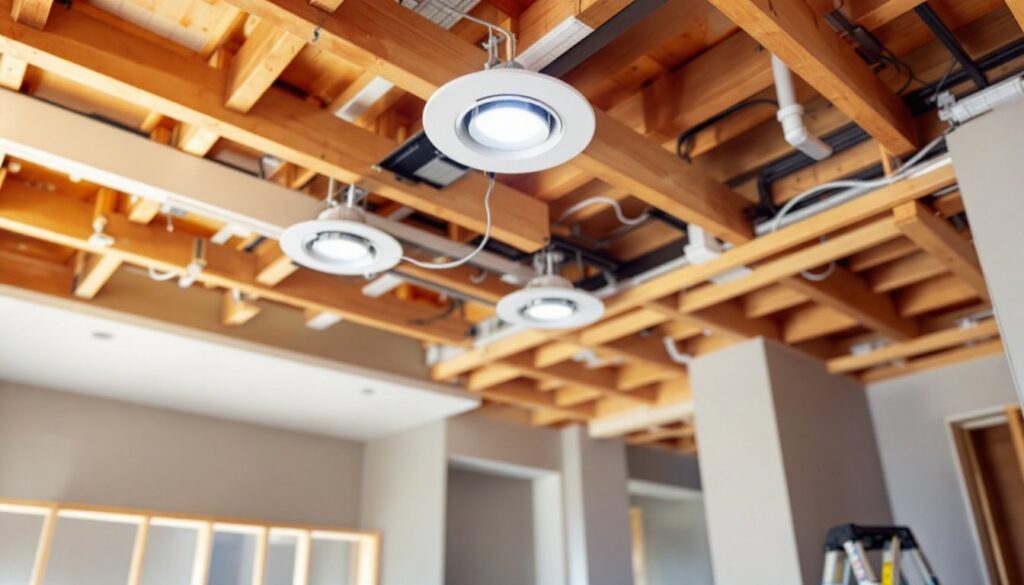
Check what’s above: Before finalizing placement, head to the attic or crawl space to locate joists, ductwork, and existing wiring. Recessed housings need clearance from insulation (IC-rated housings can touch insulation: non-IC types need 3 inches of space). Mark joist locations on the ceiling with painter’s tape, it saves frustration later.
Choose the right housing type: For remodel work (cutting into an existing ceiling), use remodel housings with integrated clips that grip the drywall from below. New construction housings won’t work here, they nail to joists before drywall goes up.
Trim size matters: Common diameters are 4-inch, 5-inch, and 6-inch. Smaller trims work for tight spacing and lower ceilings: larger ones throw more light and suit higher ceilings or larger rooms.
Tools and Materials You’ll Need
Tools
- Drywall saw or hole saw (sized to your housing’s template)
- Stud finder (with AC wire detection)
- Drill/driver with bits
- Wire strippers and wire cutters
- Voltage tester (non-contact type)
- Screwdrivers (flathead and Phillips)
- Fish tape or wire snake (for running cable through walls)
- Headlamp or work light
- Ladder (6-foot minimum for standard ceilings)
Materials
- Remodel recessed light housings (IC-rated if near insulation)
- 14/2 NM-B (Romex) cable for 15-amp circuits, or 12/2 for 20-amp circuits
- Wire connectors (twist-on or push-in type)
- Electrical tape
- Junction box (if tapping into existing wiring)
- Cable clamps and staples
- LED bulbs or integrated LED trim kits (check housing compatibility)
Safety Gear
- Safety glasses
- Dust mask (drywall dust and insulation fibers)
- Work gloves
- Knee pads (if working in an attic)
Double-check that the remodel housings match the trim style and bulb type planned for the space. Mixing incompatible components leads to fitment headaches.
Step 1: Cut the Ceiling Holes
Turn off power at the breaker panel to any circuits running through the work area. Use a voltage tester to confirm power is off, non-contact testers work through drywall.
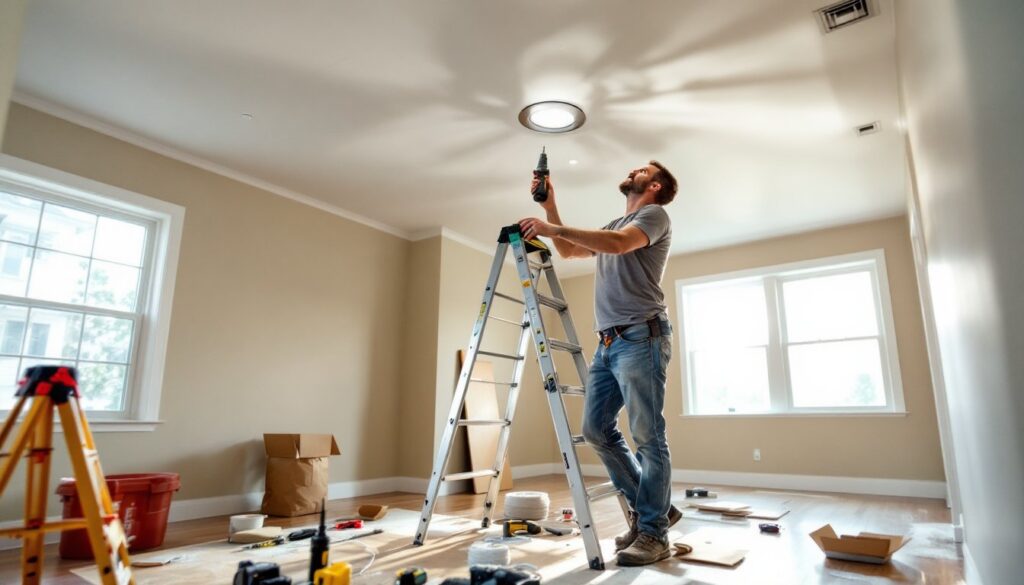
Most remodel housings include a cardboard or plastic template. Hold it against the ceiling at the planned location and trace the outline with a pencil. Before cutting, use a stud finder to confirm there’s no joist, duct, or wiring in the way.
Cutting options:
- Drywall saw (jab saw): Poke the tip through the drywall inside the traced circle, then cut along the line. It’s dusty but gives good control.
- Hole saw: Faster and cleaner, but requires a drill with enough torque. Match the hole saw diameter to the housing template (common sizes: 4⅝”, 5¾”, 6¾”).
Cut slowly near the end to avoid tearing the drywall face paper. Pull the cutout free and shine a flashlight into the cavity to check for obstructions. If a joist blocks the hole, shift the location a few inches and patch the mistake later with a drywall scrap and joint compound.
Pro tip: Lay a drop cloth directly below the work area. Drywall dust gets everywhere.
Step 2: Run Electrical Wiring
This step varies depending on whether the installer is adding lights to an existing circuit or running a new dedicated circuit from the breaker panel. If unsure about load capacity or circuit routing, consult an electrician. Overloading a circuit or incorrect wiring creates fire hazards.
Tapping Into an Existing Circuit
Locate a nearby junction box or switch with available capacity (add up the wattage of existing fixtures and compare to the circuit’s rating, 1,800 watts max for a 15-amp circuit). Turn off the breaker, confirm power is off with a voltage tester, and remove the cover plate.
Run 14/2 NM-B cable (for 15-amp circuits) from the junction box to the first recessed light location. Use a fish tape to snake the cable through the wall cavity or across ceiling joists. Staple the cable within 8 inches of boxes and every 4½ feet along joists, per NEC requirements (varies by jurisdiction, check local codes).
Daisy-chain additional lights by running cable from one housing to the next. Leave about 18 inches of extra cable at each housing for connections, it’s easier to trim excess than splice in more.
Running a New Circuit
If the existing circuit lacks capacity, run a new circuit from the breaker panel. This requires installing a new breaker, which is beyond the scope of DIY recessed lighting for most homeowners. Hiring a licensed electrician for this portion is often the safest and code-compliant choice.
Safety reminder: Never work on live circuits. Always verify power is off before handling wires.
Step 3: Install the Recessed Light Housings
Pull the cable through the knockout hole on the side of the remodel housing. Secure it with a cable clamp to prevent strain on the connections. Strip about 6 to 8 inches of the outer cable sheath using a utility knife (score lightly to avoid nicking the wires inside), then strip ½ inch of insulation from each conductor with wire strippers.
Most remodel housings feature spring-loaded clips or adjustable brackets that grip the drywall. Push the housing up into the ceiling hole until the trim flange sits flush against the ceiling. Engage the clips by pushing them outward or tightening the screws (depending on the housing design). The housing should feel snug and not rattle when tugged.
Check alignment: Stand back and eyeball the housing to ensure it’s not tilted. Crooked lights are obvious once the trim goes on.
If the housing is IC-rated, it can touch insulation. For non-IC housings, use an insulation dam or keep at least 3 inches of clearance around the housing to prevent overheating. Many recessed lighting housing options now come with integrated LED modules, which run cooler and simplify installation.
Repeat for each light, double-checking that cables are secured and housings are level before moving to the wiring stage.
Step 4: Connect and Test Your Lights
With the housings installed, it’s time to make electrical connections. Confirm power is still off at the breaker panel before handling any wires.
Wiring the Lights
Inside each housing, connect wires using twist-on wire connectors or push-in connectors:
- Black (hot) to black
- White (neutral) to white
- Bare copper (ground) to the green ground screw on the housing, then pigtail to any additional ground wires
Twist wires together clockwise before screwing on the connector. Tug each wire gently to confirm a solid connection, loose connections cause arcing and failures.
Tuck the wired connections neatly into the housing’s junction box area. Most remodel housings have enough room, but avoid cramming wires in a way that pinches or stresses them.
Installing the Trim
Snap or screw the trim ring into place according to the housing manufacturer’s instructions. Integrated LED trims usually have a plug-and-play connector: screw-in bulb trims require installing the bulb first.
LED vs. incandescent: LED bulbs are the standard now, they use 80% less energy, run cooler, and last 15–25 years. Make sure the bulb’s beam angle (narrow spot vs. wide flood) matches the room’s needs.
Testing
Restore power at the breaker panel and flip the switch. If lights don’t turn on:
- Recheck connections at the switch and each housing.
- Verify the correct breaker is on.
- Use a voltage tester to confirm power is reaching the housing.
If a specific light fails but others work, the issue is likely a loose connection or a faulty bulb in that housing.
Conclusion
Installing recessed lighting in a remodel setting requires careful planning, clean cuts, and safe electrical work, but it’s well within reach for a confident DIYer. The result, clean, modern lighting that opens up a room, is worth the effort. Always pull permits where required, and don’t hesitate to call in a licensed electrician for circuit work or troubleshooting. With the lights in and the switch flipped, the room’s transformation speaks for itself.