Table of Contents
ToggleRecessed lighting has long been the go-to choice for clean, modern ceilings, but traditional can lights come with baggage. Bulky metal housings eat up attic space, require complex framing support, and make retrofit projects a headache. Enter canless LED recessed lighting: an integrated fixture that mounts directly into your ceiling with no housing can required. These slim, self-contained units have transformed how electricians and DIYers approach lighting upgrades, cutting installation time and giving homeowners more flexibility in tight ceiling cavities. Whether you’re renovating a basement with limited clearance or simply want a cleaner install, canless LEDs offer a practical, code-compliant solution worth understanding.
Key Takeaways
- Canless LED recessed lighting eliminates bulky metal housings and complex framing, requiring as little as 2 inches of ceiling clearance compared to 6–8 inches for traditional cans, making them ideal for retrofit projects and tight spaces.
- Installing canless LED recessed lights costs $50–$100 per fixture in labor and saves significant energy—a 6-inch fixture uses 12–15 watts (roughly equivalent to 65-watt incandescent), costing only $5–$6 annually to operate versus $25+ for incandescent alternatives.
- Canless fixtures are pre-wired, UL-listed integrated units that mount directly to drywall with spring clips, requiring just a standard 4–6-inch diameter hole and eliminating the need for a separate housing, making installation straightforward for experienced DIYers.
- Canless LED recessed lighting fixtures are rated for 50,000+ hours of use (17+ years at 8 hours daily), feature factory-sealed integrated designs that prevent driver losses, and often qualify for utility rebates of $5–$10 per fixture.
- Choose canless LEDs for retrofits, limited ceiling depth, or energy efficiency; select traditional can lights if you prioritize long-term bulb flexibility, specialty housings, or already have housings installed that can accept retrofit kits.
- Canless LED models come in 4–6-inch diameters with selectable color temperatures from 2700K (warm) to 5000K (daylight), dimmable options, and smart home integration for $15–$60 per fixture depending on features.
What Is Canless LED Recessed Lighting?
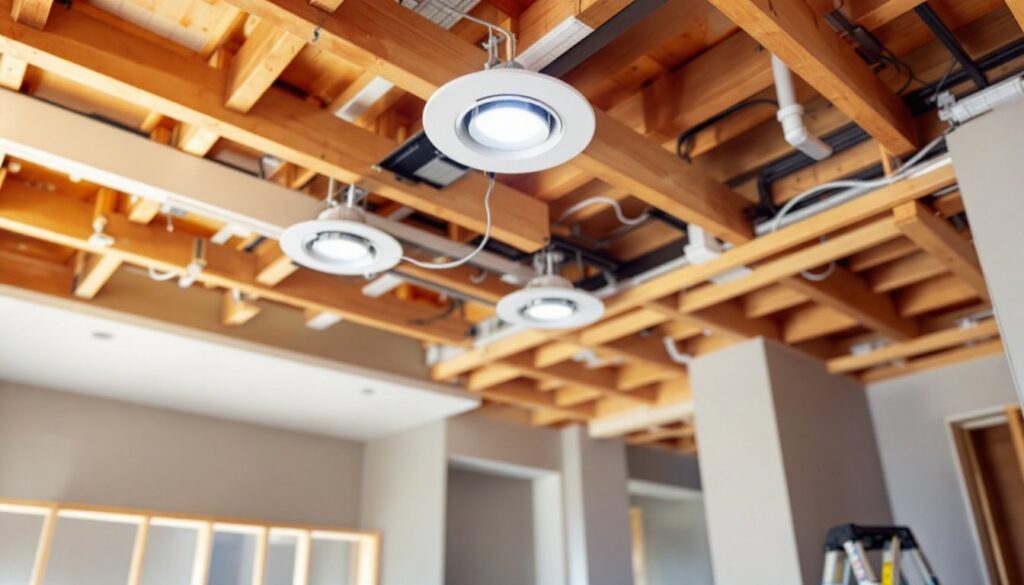
A canless LED recessed light is an all-in-one fixture that combines the LED light source, driver (power supply), and trim into a single compact unit. Unlike traditional recessed lights that require a separate metal housing (the “can”) installed above the ceiling, canless models mount directly to the drywall using spring clips or junction box connections.
Most canless fixtures measure just 2 to 3 inches deep above the ceiling line, compared to the 6 to 8 inches required for standard IC-rated or non-IC housings. This shallow profile makes them ideal for retrofit applications in finished ceilings, spaces with minimal attic access, or rooms where joists, ductwork, or insulation limit available depth.
The LED array and driver are built into the fixture and aren’t replaceable in most models, when the LEDs reach end of life (typically 50,000+ hours), you replace the entire unit. This differs from traditional can lights where you swap out bulbs or retrofit kits. Because the fixture is integrated, canless LEDs are pre-wired and often UL-listed as a complete assembly, streamlining code compliance.
Many canless models include built-in junction boxes rated for direct ceiling connection, eliminating the need for a separate box in new construction or remodel scenarios. They’re compatible with standard 120V household circuits, and most draw between 9 and 15 watts depending on brightness and diameter (typically 4-, 5-, or 6-inch apertures).
Key Benefits of Choosing Canless Recessed Lights
Energy Efficiency and Cost Savings
Canless LEDs deliver significant energy savings compared to older incandescent or halogen recessed lights. A typical 6-inch canless fixture consumes 12 to 15 watts while producing 800 to 1,000 lumens, roughly equivalent to a 65-watt incandescent. At $0.13/kWh (the U.S. average), running one fixture for 8 hours daily costs about $5 to $6 per year versus $25+ for an incandescent equivalent.
The integrated LED design also eliminates driver losses common in retrofit kits, where separate transformers can waste 10-15% of input power as heat. Most canless models carry an Energy Star certification, ensuring they meet efficiency thresholds and often qualify for utility rebates. Check with your local provider, some offer $5 to $10 per fixture rebates on qualifying LED upgrades.
Because the LEDs and driver are factory-sealed, there’s less risk of poor connections or mismatched components that can shorten lifespan. Rated lifespans of 50,000 hours translate to 17+ years at 8 hours daily use, reducing replacement costs and hassle. Modern options often integrate with smart home technology, allowing for dimming and scheduling that further cuts energy waste.
Easier Installation and Low Profile Design
Retrofit projects become dramatically simpler with canless fixtures. There’s no need to cut large holes for housings, wrestle cans into tight joist bays, or secure them with adjustable bars. Most canless lights install through a standard 4- to 6-inch diameter hole cut with a hole saw, and spring-loaded clips grip the drywall from above, locking the fixture in place without additional fasteners.
For new construction, canless units often include a mounting plate that attaches directly to a ceiling joist or between joists using the integrated junction box. No separate housing means fewer components to stock, fewer compatibility issues, and faster rough-in times. Electricians can wire the junction box, close up the ceiling, and pop the fixture in after drywall and paint are done.
The shallow profile solves clearance headaches. In older homes with 2×6 or 2×8 joists and full insulation, finding 7+ inches of clear space for a traditional can is often impossible without relocating ductwork or cutting back insulation (which can create thermal gaps). Canless fixtures need as little as 2 inches above the drywall, making them viable in nearly any ceiling cavity. They’re also lighter, most weigh under 1 pound, so mounting to drywall alone (when using the proper clips) is code-compliant and structurally sound.
How to Install Canless LED Recessed Lighting
Safety first: Turn off power at the breaker and verify with a non-contact voltage tester. Wear safety goggles when cutting drywall and work gloves when handling sharp edges.
Tools and Materials:
- Canless LED recessed light fixture(s)
- Adjustable hole saw (4″, 5″, or 6″ to match fixture spec)
- Drill/driver
- Non-contact voltage tester
- Wire strippers and wire nuts (if not pre-installed)
- Drywall saw (for fine-tuning hole size)
- Stud finder (to locate joists and avoid cutting into framing)
- Fish tape or flexible drill bit (for retrofit wiring runs)
Installation Steps (Retrofit):
-
Plan fixture locations. Use a stud finder to mark joist locations and ensure each fixture will sit between joists, not over one. Space fixtures 4 to 6 feet apart for even illumination in most rooms. Check manufacturer specs for recommended spacing.
-
Cut the ceiling hole. Mark the center point, then use the hole saw to cut a clean opening. Most canless fixtures specify a 4-5/8″ or 6-1/8″ hole for their respective sizes. Cut from below: if insulation is present above, clear it away from the opening.
-
Run power to the fixture location. If adding a new circuit, route 14/2 NM-B (for 15A circuits) or 12/2 NM-B (for 20A circuits) from the breaker panel or an existing junction box. Use a fish tape or flexible bit to pull cable through the ceiling cavity. For single fixtures on a switch loop, you’ll need hot, neutral, and ground at the fixture location. Most jurisdictions require romex to be stapled within 8 inches of a junction box and every 4.5 feet along the run, this may not be feasible in finished ceilings, so consult local code and consider hiring a licensed electrician if you’re uncomfortable with the wiring portion.
-
Connect wiring at the fixture. Strip 1/2 inch of insulation from each conductor. Connect black (hot) to black, white (neutral) to white, and ground (bare or green) to the fixture’s ground wire or grounding screw. Many canless fixtures come with push-in connectors or pre-installed wire nuts for faster connections. Fold wires neatly into the junction box portion of the fixture.
-
Mount the fixture. Push the fixture up into the ceiling hole. Spring clips on the sides will automatically deploy and grip the drywall from above, pulling the trim flush with the ceiling surface. Some models use rotating clips you manually engage: follow the manufacturer’s instructions. The fixture should sit snug with no gaps.
-
Restore power and test. Flip the breaker back on, turn on the switch, and verify the fixture lights up. Check for flickering (a sign of a loose connection) and confirm any dimming functions if using a compatible dimmer.
Permits and Code Notes:
Most jurisdictions classify adding or relocating recessed lights as electrical work requiring a permit and inspection, especially if you’re running new circuits. Canless fixtures must be UL- or ETL-listed and installed per NEC guidelines. If your ceiling has insulation, ensure the fixture is rated for insulation contact (IC-rated equivalent), most modern canless LEDs are, but verify before purchase. In areas with fire-rated ceiling assemblies (common in multifamily or commercial spaces), you may need a fire-rated canless fixture to maintain the rating.
Choosing the Right Canless LED Fixtures for Your Space
Canless LEDs come in multiple diameters, color temperatures, beam angles, and feature sets. Matching the fixture to the room’s function and design ensures you get the performance you need. When comparing options, reviews from sources like this recessed lighting guide can help narrow your choices.
Fixture Diameter:
- 4-inch: Best for accent lighting, small bathrooms, closets, or hallways. Output typically 600 to 750 lumens.
- 5-inch: Versatile for general lighting in bedrooms, dining rooms, or medium-sized spaces. Output around 700 to 900 lumens.
- 6-inch: Ideal for kitchens, living rooms, and high-ceiling areas needing more throw. Output 800 to 1,200 lumens.
Color Temperature:
Measured in Kelvin (K), color temperature affects mood and function.
- 2700K (Soft White): Warm, yellowish light similar to incandescent bulbs. Good for living rooms, bedrooms, and dining areas.
- 3000K (Warm White): Slightly crisper than 2700K, popular in kitchens and bathrooms.
- 3500K–4000K (Neutral White): Balanced tone for task lighting in workshops, home offices, or laundry rooms.
- 5000K (Daylight): Cool, bluish light for garages, basements, or spaces where you need high clarity.
Many canless fixtures now offer tunable white or selectable color temperature, letting you switch between 2700K, 3000K, 4000K, and 5000K via a switch on the fixture before installation.
Dimming Compatibility:
Most canless LEDs are dimmable, but not all dimmers work with every fixture. Look for models labeled compatible with standard TRIAC or ELV dimmers. Older rotary dimmers designed for incandescent loads can cause flickering or buzzing. If dimming is important, budget for an LED-compatible dimmer (around $15–$30) and confirm compatibility with the fixture manufacturer’s spec sheet.
Beam Angle and Optics:
- Narrow beam (25–35°): Focused light for artwork, architectural details, or task zones.
- Wide flood (90–110°): Broad, even coverage for general ambient lighting.
Some canless models include interchangeable reflector trims or adjustable gimbals for directional lighting. If you’re highlighting features or need adjustable aim, look for these options.
Smart Features:
Integrated Wi-Fi or Bluetooth canless LEDs can be controlled via app, voice assistant, or automation routines. These typically cost $25 to $50 per fixture versus $15 to $25 for standard models. Smart fixtures often include RGB color-changing modes and scheduling, useful in media rooms or kids’ spaces. Note that smart features may require a neutral wire at the switch location for full functionality.
Canless vs. Traditional Can Lights: Which Is Right for You?
Both canless and traditional can lights have their place, and the best choice depends on your project scope, ceiling conditions, and long-term plans. For broader comparisons of different fixture types, checking recessed light reviews can provide additional perspective.
Choose Canless LEDs When:
- Ceiling depth is limited. Shallow cavities, low attic clearance, or obstructions like ductwork make traditional cans impractical.
- You’re doing a retrofit in a finished ceiling. Smaller holes, no housing to wrestle into place, and faster install times reduce labor and mess.
- Energy efficiency is a priority. Integrated LEDs eliminate compatibility issues and driver losses, and most models are Energy Star certified out of the box.
- You want a modern, low-profile aesthetic. Canless trims sit nearly flush with the ceiling, often with thinner bezels than traditional cans.
- You’re a DIYer. Simpler mounting and fewer components make canless fixtures more approachable for non-professionals, though electrical work still requires care and code compliance.
Choose Traditional Can Lights When:
- You want bulb flexibility. Cans accept a wide range of bulbs (LED, incandescent, halogen, CFL) and retrofit kits, so you can swap out technology as it evolves without replacing the housing.
- You’re doing new construction. If walls are open and you have access to framing, installing IC-rated cans is straightforward, and the housings are very durable.
- You need specialty housings. Sloped-ceiling cans, airtight IC housings for high-performance homes, or fire-rated assemblies are more widely available in traditional formats.
- Long-term serviceability matters. With a traditional can, you can replace just the bulb or trim, not the entire fixture. Canless units are typically all-or-nothing replacements after 15–20 years.
- You already have housings installed. If cans are in place, adding LED retrofit kits (which convert existing cans to integrated LED) can be more cost-effective than removing housings and patching ceilings.
Cost Comparison:
Canless LED fixtures typically run $15 to $40 each for standard models, and $30 to $60 for smart or high-CRI versions. Traditional IC-rated housings cost $10 to $25, plus $8 to $30 for an LED bulb or retrofit kit, bringing per-fixture costs to a similar range. Installation labor, but, tends to favor canless in retrofit scenarios, many pros charge $75 to $150 per fixture for traditional can retrofits (due to cutting, housing install, and patching) versus $50 to $100 for canless.
Both systems are code-compliant and safe when installed correctly. The choice often comes down to how much ceiling access you have, whether you value future bulb flexibility, and how much DIY confidence you bring to the project. For most homeowners tackling a retrofit or working in tight spaces, canless LEDs deliver a faster, cleaner, and more energy-efficient result.