Table of Contents
ToggleAnyone who’s worked a dinner rush knows that commercial kitchens are lit differently, and for good reason. Poor lighting can lead to knife slips, misread tickets, and failed health inspections. Unlike a home kitchen where a couple of pendant lights might suffice, commercial spaces demand higher output, code-compliant fixtures, and strategic placement that keeps pace with fast-moving prep, cook, and cleaning workflows. This guide walks through the requirements, fixture types, and layout strategies that make commercial kitchen lighting effective, safe, and energy-smart.
Key Takeaways
- Commercial kitchen lighting must meet FDA Food Code minimums of 50 foot-candles in food prep areas and comply with local health and building codes to ensure safety and prevent contamination.
- LED vapor-tight fixtures are the most reliable option for commercial kitchen lighting, offering 50,000-hour lifespans and 50-60% energy savings compared to fluorescent alternatives.
- Strategic fixture placement directly above prep stations, cooking lines, and dishwashing areas eliminates shadows and glare while reducing worker injury risk and increasing operational efficiency.
- A full LED retrofit in a mid-size commercial kitchen pays for itself in 2-4 years through energy and maintenance savings, with total installed costs typically ranging from $3,000–$7,000.
- High Color Rendering Index (CRI) of 80 or higher is essential for accurate food assessment, ensuring staff can correctly judge doneness, freshness, and plating quality.
Why Commercial Kitchen Lighting Differs from Residential Lighting
Commercial kitchens operate under regulations that residential spaces don’t face. Health departments and fire marshals inspect lighting as part of sanitation and safety compliance. Fixtures must be cleanable, shatterproof, and capable of delivering consistent illumination across large work zones.
Heat and moisture are constant. Grills, fryers, and steamers push ambient temps well above what a home kitchen sees, and humidity from dishwashers and cooking processes can corrode standard fixtures in months. Commercial-grade housings use sealed lenses and corrosion-resistant materials, typically aluminum or stainless steel, to survive the environment.
Operational hours are longer. A restaurant kitchen might run 12-16 hours daily, compared to a few hours in a home. Fixture lifespan and energy draw become critical cost factors. Bulbs that burn out frequently disrupt service and drive up labor costs for maintenance.
Task intensity is higher. Line cooks need to see knife work, plating details, and doneness cues at a glance. Residential kitchens rarely require the same precision under pressure, so lower light levels suffice.
Essential Lighting Requirements for Commercial Kitchens
Building codes and health regulations set minimum standards, but good design goes further. Most jurisdictions reference the International Building Code (IBC) and local health department rules. Verify requirements with your authority having jurisdiction (AHJ) before finalizing plans.
Illumination Levels and Safety Standards
Foot-candles (fc) measure light intensity. The FDA Food Code recommends 50 fc at surfaces where food is prepared or equipment/utensils are cleaned, and 20 fc in walk-in coolers, dry storage, and other non-prep areas. Some local codes push prep area minimums to 75 fc or higher.
Measure light levels with a foot-candle meter (around $30-$150 for basic models). Take readings at counter height, typically 36 inches, to match actual work surfaces.
Shatterproof or shielded fixtures are often required above food prep and cooking areas to prevent glass contamination if a bulb breaks. Look for fixtures rated wet or damp location depending on proximity to sinks, dishwashers, and steam equipment.
Color Rendering Index (CRI) matters for food safety. A CRI of 80 or higher ensures that staff can accurately judge doneness, freshness, and plating aesthetics. Low-CRI lights (common in older fluorescents) can make raw chicken look cooked or fresh greens appear wilted.
Electrical codes (NEC Article 422 for commercial cooking equipment) may dictate fixture placement relative to hoods, gas lines, and ventilation systems. Always coordinate with a licensed electrician familiar with commercial kitchen work.
Best Types of Light Fixtures for Commercial Kitchen Spaces
Not all fixtures handle grease, heat, and humidity equally. Here’s what works in commercial kitchens and why.
LED vapor-tight fixtures are the workhorse. These sealed units mount flush to ceilings and resist moisture and dust. They’re common over prep tables, dishwashing areas, and walk-ins. Expect 4-foot or 8-foot lengths in 40W to 80W configurations, delivering 4,000 to 10,000 lumens per fixture. Lifespan typically hits 50,000 hours, reducing relamping frequency.
High-bay LED fixtures suit kitchens with ceilings above 12 feet. These deliver concentrated downlight and often include reflectors to maximize efficiency. They’re overkill for standard 9- to 10-foot ceilings but essential in large commissary or institutional kitchens.
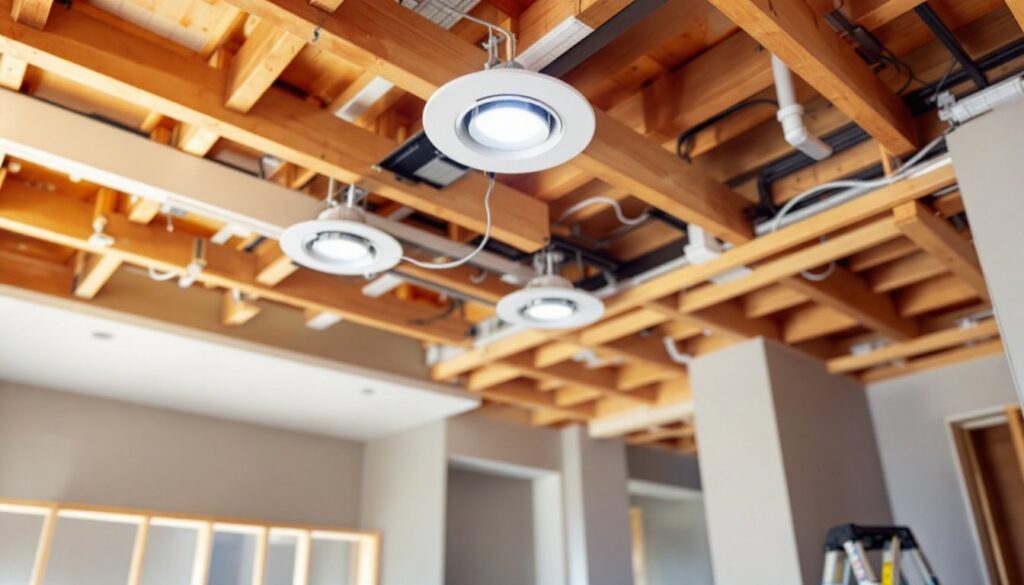
Recessed canister lights work in front-of-house transition zones (expediting stations, service counters) where aesthetics matter. Use IC-rated housings if they’re near insulation, and match recessed housing types to your ceiling construction. These don’t replace general task lighting but supplement it.
Track or rail-mounted fixtures offer flexibility in smaller kitchens or during layout changes. Mount them on stainless steel or aluminum tracks that can be wiped down. Avoid decorative track systems designed for residential use, they won’t hold up.
Smart lighting systems are gaining traction in newer builds. Fixtures with occupancy sensors or dimming capability can cut energy costs in storage areas and off-peak hours. Brands integrating with smart home ecosystems offer remote monitoring and scheduling, useful for multi-site operations.
Avoid bare incandescent or halogen bulbs, they generate excessive heat, waste energy, and create burn hazards. Old T12 fluorescent fixtures are inefficient and often use ballasts that hum or flicker. If retrofitting, swap in LED tubes compatible with existing sockets or replace the entire fixture.
Strategic Lighting Placement for Maximum Functionality
Layout drives functionality. Poor placement creates shadows, glare, and dark zones that slow work and increase injury risk.
Over prep stations and cutting boards: Mount fixtures directly above work surfaces to eliminate shadows cast by the worker’s body. Space 4-foot vapor-tight LEDs every 4 to 6 feet for even coverage. If the station is against a wall, position the fixture 12 to 18 inches out from the wall to reduce head shadows.
Above cooking lines: Install fixtures between the hood and cook surface, not inside the hood (heat and grease kill bulbs fast). Many commercial hoods include integral task lighting, but it’s often insufficient. Supplement with ceiling-mounted fixtures 3 to 4 feet in front of the range.
Dishwashing and sanitation zones: Wet-rated fixtures are mandatory here. Aim for uniform light, avoid single-point sources that create glare on stainless steel surfaces. Proper lighting maintenance in these high-humidity areas prevents early fixture failure.
Walk-in coolers and freezers: Use low-temperature-rated LED fixtures (many standard LEDs dim or fail below 32°F). Mount them near the door and center of the space. Vapor-tight housings prevent condensation buildup.
Storage and dry goods areas: Lower light levels (20 fc) are acceptable, but don’t skimp. Staff need to read labels and check expiration dates. Motion sensors here save energy without sacrificing safety.
Emergency and exit lighting: Required by code in most commercial kitchens. Battery-backup fixtures or separate emergency circuits ensure egress lighting during power failures.
Consider general interior lighting principles when planning transitions between kitchen and dining areas, sudden brightness changes cause eye strain and slow staff movement.
Energy Efficiency and Cost Considerations
Lighting can represent 10-20% of a commercial kitchen’s energy bill. Smart choices up front pay off.
LED vs. fluorescent: LEDs cost more initially but use 50-60% less energy than T8 fluorescents and last 3-5 times longer. For a kitchen running 14 hours daily, a 40W LED replacing a 96W fluorescent saves roughly 280 kWh annually per fixture. At $0.12/kWh, that’s $34/year per fixture. Multiply by 20 fixtures and you’re saving $680 annually.
Rebates and incentives: Many utility companies and state energy offices offer rebates on LED upgrades for commercial spaces. Check DSIRE (Database of State Incentives for Renewables & Efficiency) and your local utility’s business programs. Rebates can offset 20-40% of fixture costs.
Dimming and controls: Occupancy sensors and daylight harvesting (if the kitchen has windows) can cut energy use another 10-30%. Ensure sensors are rated for commercial environments, false triggers in busy kitchens cause frustration.
Maintenance costs: Frequent relamping adds labor. If changing a bulb takes 15 minutes and you’re paying $20/hour, that’s $5 per swap. LEDs’ longer lifespan (50,000 hours vs. 15,000 for fluorescents) reduces these hidden costs.
Fixture quality matters: Cheap fixtures fail early. Look for UL or ETL listings, IP65 or higher ratings for wet locations, and warranties of 5 years minimum. A $60 vapor-tight LED that lasts a decade beats a $30 unit that fails in two years.
Total cost of ownership: Factor in purchase price, installation (commercial electrical rates run $75-$150/hour in most markets), energy use over 10 years, and maintenance. A full LED retrofit in a mid-size kitchen (15-25 fixtures) typically costs $3,000-$7,000 installed, with payback in 2-4 years via energy savings.
For detailed fixture selection, explore options in our lighting fixtures guide, which covers residential and commercial applications.
Conclusion
Commercial kitchen lighting isn’t about ambiance, it’s about safety, efficiency, and regulatory compliance. Invest in code-compliant, high-CRI LED fixtures, place them strategically to eliminate shadows and glare, and factor in long-term energy and maintenance costs. When in doubt, consult a licensed electrician and your local health department before finalizing plans. Good lighting keeps the kitchen running smoothly, your staff safe, and inspectors satisfied.