Table of Contents
ToggleInstalling recessed lighting during new construction offers a clean, modern aesthetic that’s hard to beat. Unlike retrofit projects, new construction installs let you work with open ceilings, exposed joists, and unrestricted access, making the job faster, cleaner, and more forgiving. Whether you’re building from scratch or adding onto an existing home, understanding the nuances of housing types, spacing, and electrical requirements will save time and headaches down the line. This guide walks through everything needed to plan and install recessed lighting correctly the first time.
Key Takeaways
- New construction recessed lighting offers faster installation and design flexibility compared to retrofit projects because open framing provides unrestricted access and precise fixture positioning before drywall installation.
- IC-rated (insulation contact) recessed housings are essential for most modern builds, as they allow insulation to sit directly against fixtures without fire hazards, making them the default choice over non-IC alternatives.
- Proper spacing prevents dark spots and uneven illumination—divide ceiling height by 2 to determine spacing in feet (e.g., 8-foot ceiling = 4-foot spacing), with closer placement for task areas like kitchen counters.
- Bulb selection and trim style significantly impact performance and aesthetics; LED bulbs rated for recessed cans in 2700K–3000K for warm spaces and 3500K–4000K for task areas deliver efficiency and appropriate light distribution.
- An electrical permit and professional inspection are required in most jurisdictions before drywall installation to ensure proper wire gauge, grounding, and safety compliance.
- Common installation errors include using non-IC-rated housings with insulation, incorrect wire gauge, overloading circuits, and poor cable management—avoiding these mistakes protects both safety and long-term fixture performance.
Why Choose Recessed Lighting for New Construction Projects
Recessed lights, also called can lights or downlights, sit flush with the ceiling, eliminating visual clutter and providing targeted illumination without eating up headroom. In new construction, they’re particularly appealing for several reasons.
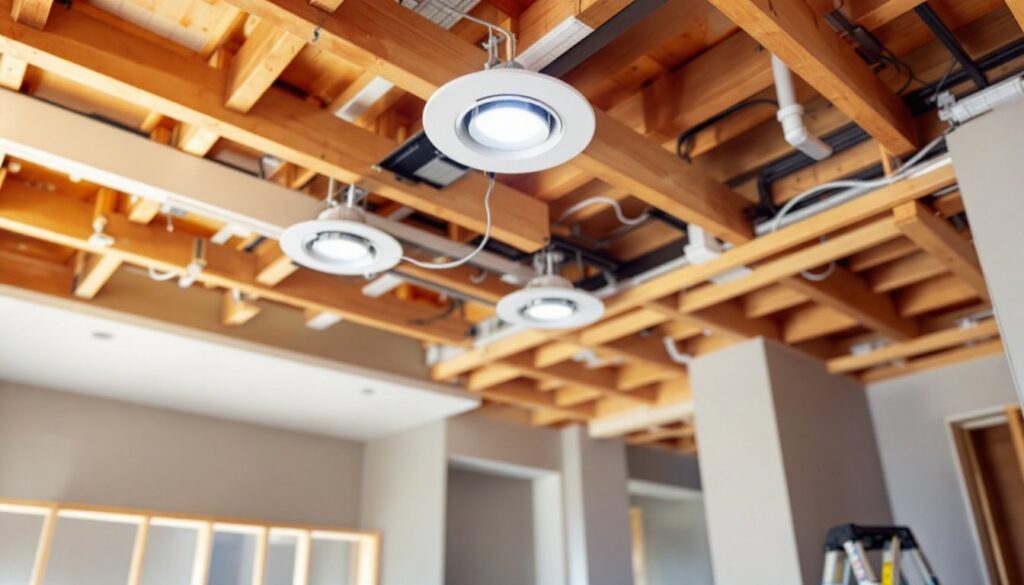
First, installation is simpler. Open framing means you can position fixtures precisely between joists, run wire without snaking through finished walls, and adjust placement before drywall goes up. There’s no patching, no crawling through attics, and no guessing where studs are.
Second, they integrate seamlessly with insulation. Using IC-rated (insulation contact) housings allows insulation to sit directly against the fixture without creating fire hazards or efficiency gaps, critical for meeting modern energy codes.
Third, recessed lights offer design flexibility. They work in any room, kitchens, bathrooms, hallways, living areas, and pair well with other lighting layers (chandeliers, pendants, sconces). Adjustable trims let you direct light where it’s needed, while dimmer compatibility adds ambiance control.
Finally, they’re cost-effective at scale. Buying fixtures in bulk for a whole-house install often brings unit costs down, and the labor savings compared to retrofit work can be significant. Just be aware that most jurisdictions require a licensed electrician or electrical permit for new circuits, even in DIY-friendly areas.
Types of New Construction Recessed Lights
New construction recessed housings differ from remodel (retrofit) cans in how they attach. New construction housings use adjustable bars or flanges that nail or screw directly to ceiling joists before drywall installation. The housing hangs below the joists, and the trim installs after drywall and paint are complete.
Most housings fall into a few size categories: 4-inch, 5-inch, and 6-inch diameter openings. Smaller cans work well for accent lighting or tight spaces like closets: 5-inch and 6-inch cans provide general illumination for living areas and kitchens.
Shallow (low-profile) housings are available for ceilings with limited plenum space, attics with low clearance or areas above drop ceilings. Standard housings need about 6–8 inches of clearance above the drywall.
Another consideration: airtight-rated housings. These have sealed backs to prevent conditioned air from escaping into the attic, which improves energy efficiency and can be required by some energy codes like California’s Title 24.
IC-Rated vs. Non-IC-Rated Housing
The IC rating (insulation contact) is perhaps the most important specification to understand. IC-rated housings are designed to be covered by insulation without overheating. They have thermal protection that shuts off the fixture if it gets too hot, preventing fire risk.
Non-IC-rated housings require at least 3 inches of clearance from insulation on all sides. In practice, this often means creating a box or dam around the fixture in the attic, a hassle that reduces insulation effectiveness and creates thermal weak points.
For most modern new construction projects, IC-rated housings are the default choice. They cost only marginally more than non-IC versions and eliminate compatibility issues with blown-in or batt insulation. Unless you’re installing in an uninsulated space (like a garage or covered porch), go with IC-rated every time.
Planning Your Recessed Lighting Layout
Proper spacing prevents dark spots and over-lighting. A common rule of thumb: divide the ceiling height (in feet) by 2 to get spacing in feet. For an 8-foot ceiling, space lights roughly 4 feet apart. For 10-foot ceilings, try 5 feet.
But spacing isn’t one-size-fits-all. Task areas like kitchen counters benefit from closer spacing (3–4 feet) and positioning 18–24 inches from the wall to illuminate work surfaces. In bedrooms or hallways, you can go wider, 5–6 feet, since ambient light needs are lower.
Avoid placing cans too close to walls. A light centered 12–18 inches from the wall creates a wash of light down the surface, preventing harsh shadows and making the room feel larger. Lights placed right against walls waste lumens and create glare.
When laying out over joists, remember that ceiling joists typically run 16 or 24 inches on center. You’ll install housings between joists, so sketch a rough framing plan before buying fixtures. If your ideal layout puts a light where a joist runs, you’ll need to adjust.
Check for conflicts with HVAC ducts, plumbing vents, or structural members in the ceiling cavity. Walk the attic or review framing plans to avoid surprises. In bathrooms, maintain clearance from showers or tubs unless the fixture is rated for wet or damp locations.
Finally, plan your switching and dimming. Decide which lights will be on the same circuit and where switches will go. Dimmable LED drivers or bulbs require compatible dimmers, standard dimmers may cause flickering or buzzing.
Step-by-Step Installation Process
Safety first: Turn off power at the main panel and use a non-contact voltage tester to confirm circuits are dead. Wear safety glasses and gloves when handling metal housings and cutting wire.
Materials you’ll need:
- New construction recessed housings (IC-rated, airtight if required)
- 14/2 or 12/2 NM-B (Romex) cable, depending on circuit amperage
- Wire nuts or push-in connectors
- Cable clamps (if not integrated in the housing)
- Drywall screws or nails (for mounting bars)
- Voltage tester
Tools:
- Drill/driver
- Wire strippers
- Lineman’s pliers
- Tape measure
- Pencil
- Ladder or work platform
Installation Steps
-
Mark fixture locations on the ceiling joists or subfloor above. Use a pencil and tape measure, referencing your layout plan.
-
Attach the mounting bars to the joists. Most new construction housings have extendable bars that slide to fit joist spacing. Secure with screws or nails per the manufacturer’s instructions. The housing should hang at the correct depth so the trim flange will sit flush with the finished drywall (usually ½ inch thick).
-
Run electrical cable from the power source (a junction box or switch) to the first fixture, then daisy-chain from fixture to fixture. Leave about 18 inches of slack at each housing for connections. Secure cable with staples within 8 inches of each box and every 4½ feet along the run, per NEC requirements.
-
Make electrical connections inside each housing. Strip about 6 inches of outer sheathing, then ¾ inch of insulation from individual wires. Connect black (hot) to black, white (neutral) to white, and bare copper (ground) to the housing’s ground screw or wire. Use wire nuts and wrap connections with electrical tape for added security. Tuck wires neatly into the junction box.
-
Secure the housing. Some models require additional screws or clips to lock the canister in place. Follow the provided instructions, improper mounting can cause the fixture to sag after drywall.
-
Install drywall around the housings, cutting openings as needed. The trim ring will cover the edge, so cuts don’t need to be perfect, but avoid large gaps.
-
After painting, install the trim and bulb. Push the trim’s spring clips into the housing slots until they lock. Insert the appropriate LED bulb or module (more on that below).
-
Restore power and test. Check each fixture for proper operation and inspect for flickering or buzzing, which may indicate a wiring issue or incompatible dimmer.
Permit and inspection: Most jurisdictions require an electrical permit for new circuits. The inspector will verify proper wire gauge, grounding, and box fill before drywall goes up. Don’t skip this, it’s about safety and resale value.
Common Mistakes to Avoid
Using non-IC-rated housings with insulation. This is a fire hazard and code violation in most areas. Always match the housing to the insulation situation.
Incorrect wire gauge. A 15-amp circuit requires 14-gauge wire: a 20-amp circuit needs 12-gauge. Mixing them or using undersized wire creates overheating risk. When in doubt, pros often install recessed lighting with 12-gauge wire for future flexibility, though homeowners frequently draw inspiration from design platforms like Houzz when planning their layouts.
Overloading a circuit. Each recessed light draws watts depending on the bulb. Add up the total wattage on a circuit and keep it under 80% of the breaker rating (12 amps on a 15-amp circuit, 16 amps on a 20-amp).
Poor spacing or placement. Lights too far apart leave dark zones: too close together creates hot spots and wastes energy. Measure twice, install once.
Forgetting to leave wire slack. Pulling cable taut makes future repairs or adjustments nearly impossible. That extra foot of wire is cheap insurance.
Skipping the airtight test. If your housings claim to be airtight, inspect the gaskets and seals before drywall. A missing gasket defeats the purpose.
Incompatible dimmers. Not all LED bulbs dim smoothly with standard dimmers. Use a dimmer rated for LED loads, and check the bulb packaging for compatibility.
Choosing the Right Bulbs and Trim Options
Bulb type matters. Modern recessed fixtures almost universally use LED bulbs or integrated LED modules. LEDs last 25,000–50,000 hours, draw a fraction of the power of incandescent or halogen bulbs, and generate less heat, critical for enclosed housings.
Look for bulbs labeled for use in recessed cans. Many recessed lighting housing systems now feature integrated LED modules, which can’t be replaced but offer the best efficiency and beam control.
Color temperature shapes the room’s feel. 2700K–3000K (warm white) works well in living rooms and bedrooms, mimicking incandescent light. 3500K–4000K (neutral white) suits kitchens and bathrooms. 5000K+ (daylight) is too clinical for most homes but fine for workshops or garages.
Lumens, not watts, measure brightness. For general lighting, aim for 600–800 lumens per fixture in a 6-inch can. Task lighting may need 1000+ lumens, while accent lighting can go lower.
Trim Styles
Trim is the visible part of the fixture and affects both aesthetics and light distribution.
- Baffle trim: Ribbed interior reduces glare. Common in bedrooms and living areas.
- Reflector trim: Smooth, mirror-like finish maximizes light output. Good for kitchens and task lighting.
- Adjustable (eyeball) trim: Lets you aim the beam. Ideal for highlighting artwork or architectural features.
- Shower trim: Sealed lens for wet locations. Required in showers or above tubs.
- Open trim: Simple ring, often used with decorative bulbs.
Finish options, white, black, brushed nickel, bronze, should match your ceiling and fixtures. White blends into most ceilings: darker finishes can create a modern, contrasted look but are more noticeable.
For those seeking additional guidance on home improvement projects, resources like Bob Vila offer expert recommendations across a wide range of topics. Choosing trim and bulbs that align with the room’s function and design intent ensures your recessed lighting performs as intended for years to come.